The camera aisle at a electronics store has become a strange place. Rows of compact cameras sit under glass, many of them priced higher than the phone in a shopper's pocket, and the phones take sharper pictures of the same birthday party. A reasonable person walks past that glass and keeps walking. The compact camera, as a category, has spent the last decade absorbing the fact that the average pocket device now handles the average photograph better than most dedicated cameras ever did.
Yet the cameras keep selling. Not in the volumes of 2008, when every family had a point-and-shoot in a drawer, but in a persistent trickle that has kept a handful of models in production. That trickle is not nostalgia and it is not confusion. There are buyers, specific ones, for whom the phone is the wrong tool, and the reasons are more concrete than the marketing departments tend to admit.
The Optical Zoom That No Phone Has Matched
Start with the physical lens. A phone's main camera is wide, roughly 24 to 26 mm equivalent, and its telephoto module is small and dim. A compact with a 1-inch sensor and a 24-200 mm zoom carries glass that gathers light across a range no phone can match without stacking folded prisms and software.
The difference shows up at the long end. A child on a stage forty meters away, under stage lighting, is a smear of noise from a phone's digital crop. The same child through an 8x optical zoom, even on a small sensor, is a photograph with recognizable features and real color. The compact wins that frame every time, and the parents in the back row know it.
This is the buyer who should be holding a compact: the person who repeatedly finds themselves at the far end of a room from the thing they want to photograph. Recitals, school sports, wildlife at a feeder, a speaker at a conference. The phone's telephoto is a convenience; a compact's zoom is a tool.
A Sensor Larger Than a Fingernail
Phone cameras have gotten excellent at processing their way around a tiny sensor. Computational photography stacks multiple frames, denoises aggressively, and reconstructs detail. The results are often lovely and almost always a little smoothed, the skin of a face polished until it resembles a mannequin's.
A compact with a 1-inch sensor, the size inside a Sony RX100 or a Canon G7X, has roughly four times the light-gathering area of a phone's main sensor. That matters most in dim rooms and at dusk, where the phone must push its ISO into the noise floor and the compact still has headroom. The compact's files also hold up when pushed in editing; a phone's JPEGs fall apart when shadows are lifted two stops.
The buyer here is the person who edits. Not professionally, necessarily, but someone who wants a raw file, who wants to bring up the shadows in a backlit portrait, who notices that the phone's version of a sunset has been saturation-boosted into something the sky never was. A compact used in raw mode delivers a file with room to work. A phone delivers a finished product with the manufacturer's taste baked in.
The Case for a Camera That Does Only One Thing
There is a behavioral argument that gets less attention than the technical one. A phone is a portal to everything: messages, notifications, the entire internet, a dozen apps engineered to interrupt. Raising it to take a photograph means entering that portal, and the photograph is often a brief pause on the way to something else.
A compact camera does one thing. It takes pictures. It does not buzz. A photographer using one tends to slow down, to compose, to wait for the light, because there is nothing else to do with the device. The constraint is the point. A camera that cannot check email is a camera that keeps attention on the subject.
This buyer is the person who wants to photograph deliberately, who finds the phone's endless capability a distraction, who has noticed that the pictures they take with a dedicated device feel different because the act of taking them felt different. The compact is a commitment device, a small object that says: this moment is worth a few seconds of undivided attention.
The Physical Controls and the Viewfinder
A phone has a screen and a shutter button. A compact has dials for aperture and exposure compensation, a lens ring, sometimes a viewfinder. Those controls are not decoration. They are the difference between setting an exposure and guessing at one.
Consider a backlit scene, a person in a doorway with a bright street behind. On a phone, the user taps the subject repeatedly and hopes the metering agrees. On a compact, the user turns the exposure compensation dial two clicks down, checks the histogram, and takes the shot. The second method is faster and more reliable, and it teaches the photographer something about light in the process.
The viewfinder deserves its own note. Holding a camera to the eye changes the posture of photographing; it steadies the hands, blocks the glare of a screen, and puts the photographer's attention through a single window instead of across a glowing rectangle. On a bright day at the beach, a phone screen becomes a mirror. A viewfinder remains a window.
The Compact That Fits in a Jacket Pocket
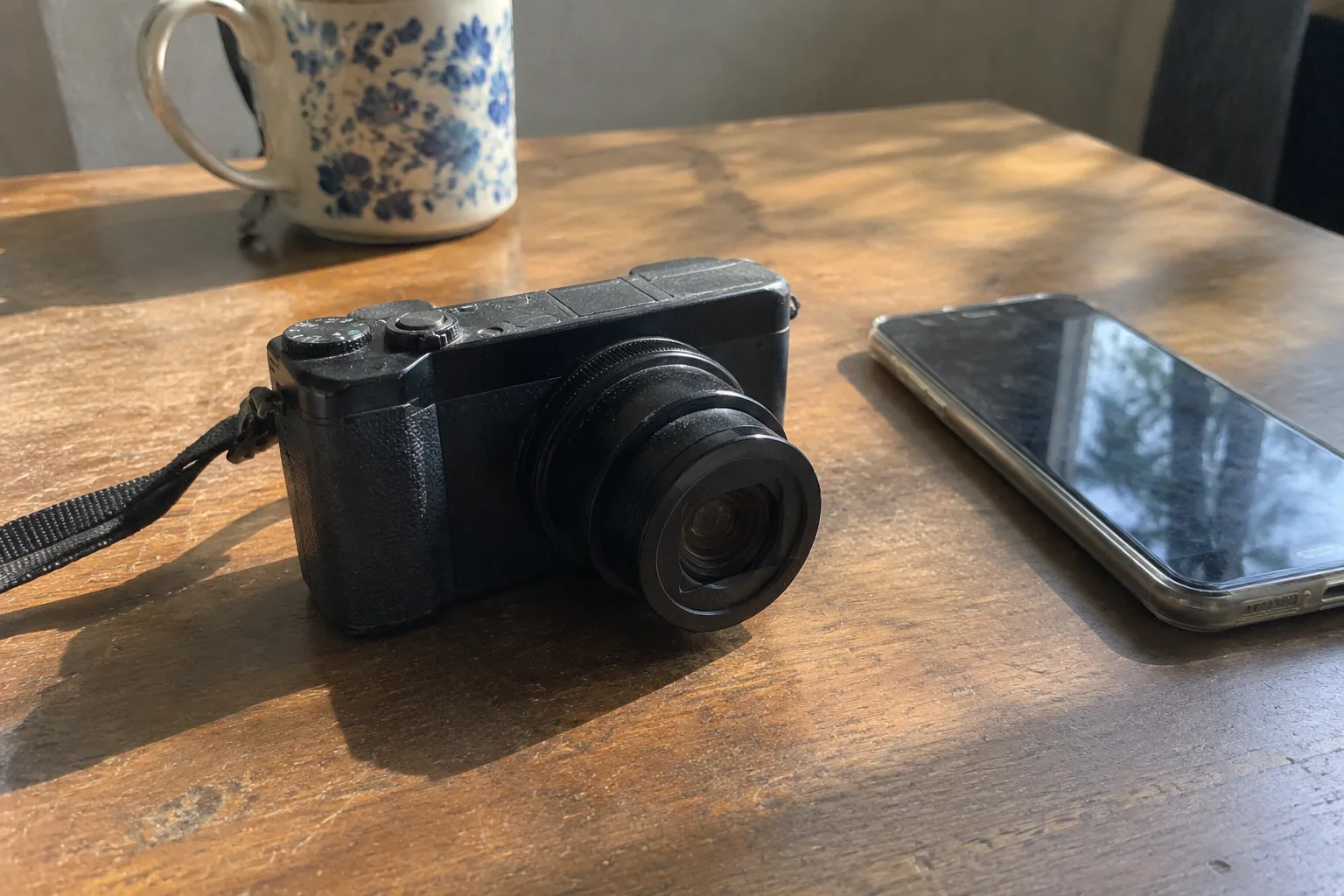
The category has split into two halves that barely resemble each other. One half is the big-sensor, big-zoom compact, the kind that costs several hundred dollars and weighs enough to need a strap. The other half is the pocketable camera, small enough to disappear into a jacket pocket, with a fixed lens and a sensor smaller than a phone's.
The pocketable half is where the phone has won most decisively. A camera with a 1/2.3-inch sensor and a slow lens offers no advantage over a modern phone, and often a disadvantage. The buyers still drawn to that end of the market are usually chasing a look, the soft grain and color rendering of a specific older model, and that is a legitimate reason to buy a camera but a narrow one.
The big-sensor half is where the compact still makes sense. A 1-inch compact with a fast lens and a decent zoom occupies a pocket of capability that phones have not filled: good enough in low light, long enough at the telephoto end, small enough to carry without a bag. That is the compact worth buying.
The Photographer Who Wants a File, Not a Post
Social media has trained a generation to think of a photograph as a post, a square, a story that disappears in a day. The compact camera appeals to the person who thinks of a photograph as a file, something that will be backed up, printed, maybe framed, maybe looked at in twenty years.
That person cares about things the phone does not emphasize: color depth, dynamic range, a raw format, a lens that renders skin tones without the phone's characteristic warmth boost. They may print occasionally. They may keep a folder of favorites. They may simply want the file to be theirs, not a company's processed interpretation of the scene.
This is not nostalgia for film or a rejection of convenience. It is a preference for a certain kind of artifact, one that holds more information and less opinion. A compact camera produces that artifact. A phone produces a product.
Who Should Keep Walking Past the Glass
The honest answer is that most people should keep walking. The phone in a pocket is a remarkable camera, and for the vast majority of photographs taken in a given day, it is the right tool. The birthday party, the dog in the park, the plate of food, the selfie with a friend: the phone handles all of it well, and it handles it while being the same device that sends the photograph to the friend.
A person who takes a dozen photographs a week, who never prints, who never edits, who never finds themselves far from their subject, gains little from a compact. The camera would be a second device to charge, to carry, to remember. It would spend most of its life in a drawer, and the phone would keep winning by default.
The compact earns its place only when it solves a problem the phone has. A long zoom solves a problem. A larger sensor solves a problem. A viewfinder and physical dials solve a problem. A device that cannot distract solves a problem. The buyer should be able to name the problem before spending the money, and the problem should be specific enough that the camera answers it.
The Used Market and the Five-Year-Old Flagship
One practical route into the category is the used market. A flagship compact from five years ago, a Sony RX100 mark something or a Canon G7X, sells for a fraction of its launch price and still produces files that embarrass a phone in good light. The sensor has not degraded. The lens is still glass. The controls still work.
Buying used changes the calculus. A person who is unsure whether a compact will earn its keep can spend a modest amount on a used model, carry it for a season, and discover whether the zoom or the viewfinder or the raw files actually change the photographs they take. If it does, the upgrade to a current model makes sense. If it does not, the loss is small and the lesson is clear.
That is the quiet argument for the compact in an era of excellent phones: it is a tool a person can try, and the trying teaches them what they actually want from a photograph. The phone answers almost every question. The compact answers a few specific ones, and for the right person those few are the ones that matter.