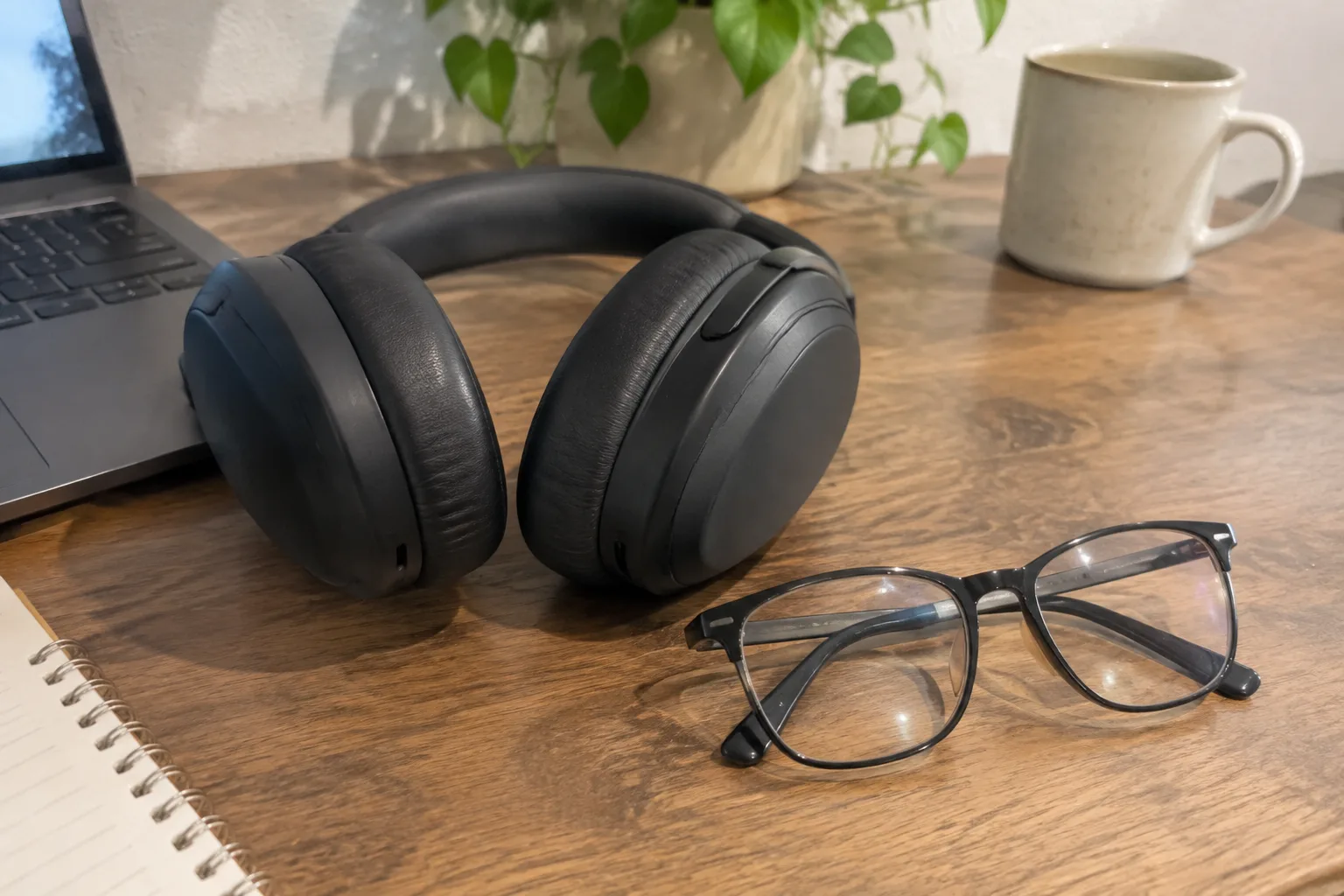
The number that matters most in a pair of over-ear headphones almost never appears on the spec sheet. Sensitivity, driver diameter, codec support, battery hours: all printed in tidy rows. Clamp force shows up nowhere, and it decides whether a pair of headphones survives a two-hour flight or gets ripped off after twenty minutes. For anyone who wears glasses, that hidden number carries extra weight, because the arms of a frame sit exactly where the headband and earcups squeeze hardest.
Headphones are engineered to stay put. A frame is engineered to stay on a face. Both jobs happen in the same few square centimeters behind the ear, and the two devices have never agreed on how much pressure is polite.
What Clamp Force Actually Measures
Clamp force is the inward pressure the headband applies to hold the earcups against the skull. Manufacturers tune it in the factory and rarely publish it. A loose band slides off during a head nod; a tight band seals better for bass response and passive noise isolation. That trade-off is the entire design problem in miniature.
The force concentrates at two points. Under the headband on the crown, and around the ears where the cups press against the temporal bone. Glasses wearers add a third contact point: the temple arm, a rigid piece of acetate or titanium about 2 mm thick, trapped between the ear and the cushion.
Two millimeters does not sound like much. On a tight pair, it feels like a small stone wedged behind the ear for the length of an album.
The Pressure Stack Behind the Ear
Think of it as layers. The earcup cushion compresses, the temple arm resists, the skin and the tissue over the mastoid bone absorb the rest. Every layer has to give somewhere. When the cushion is soft and deep, the frame sinks into it and the seal reforms around the arm. When the cushion is thin and firm, the arm becomes a hard ridge and the seal breaks along its path.
A broken seal has an audible cost. Bass leaks out, and the headphones compensate by pushing the driver harder, which is why some glasses wearers notice thin low end on cans that review well for everyone else. The seal problem and the comfort problem share a root cause.
There is also the matter of angle. Most frames sit at a slight rearward tilt from the hinge to the ear. Cushions are usually flat or gently contoured. The geometry clashes, and the arm digs into the cushion at one point rather than lying flat across it.
Why Tight Cans Hurt Glasses Wearers More
The obvious answer is pressure, and pressure is real. But the sharper problem is pressure applied to a small area. A headband distributing 3 newtons across the crown is fine. The same force channeled through a temple arm into a strip of skin a few millimeters wide reads to the nervous system as a pinch, and the body responds to a pinch by asking the wearer to move.
Long sessions compound it. After an hour, the skin under the arm grows tender; after two, the frame itself starts to feel like it is being pushed forward, and the wearer adjusts the glasses, which shifts the arm, which finds a new sore spot. The cycle is familiar to anyone who has tried to work a full day in closed-back headphones over a pair of thick acetate frames.
Cushion Depth Does More Than Clamp Force
Here is where most buying advice goes wrong. Shoppers hunt for headphones advertised as "low clamp" and ignore the cushions. In practice, a moderately tight pair with deep, memory-foam pads treats glasses better than a loose pair with shallow pads, because depth creates a channel for the frame to occupy.
Depth matters more than softness. A plush but thin cushion bottoms out against the frame; a firmer but thicker cushion keeps the cup's rigid interior away from the arm. The ideal is roughly 2 cm of usable depth at the point where the arm crosses, enough that the frame never touches hard plastic.
Pad material changes the feel, too. Velour breathes and slides, which lets the arm settle without snagging. Leatherette seals better but grabs, and on a warm commute it turns the contact patch clammy. Neither is universally better; the choice depends on whether the wearer runs hot or prioritizes isolation.
Frame Material and Arm Thickness
The headphones get all the blame, but the glasses are half the equation. A thin titanium arm, maybe 1.5 mm, disappears under a decent cushion. A chunky acetate frame with a 4 mm arm will press through almost anything. Spring hinges help by letting the arm flex outward instead of fighting the cup.
Wearers with thick frames have a few practical moves. A slightly wider headband setting lowers the cups on the ear, which changes where the arm crosses the cushion. Some people swap to a second, thinner-framed pair for desk work. Others accept a small compromise in seal in exchange for an arm that no longer throbs.
Open-Back Designs and the Lighter Band
Open-back headphones tend to run looser than closed-back models, partly because they do not need a perfect seal to sound right. That makes them a natural fit for glasses wearers who listen at a desk. The trade-off is sound leakage and almost no isolation, so they are a poor choice on a train or in a shared office.
Some open-back bands use a suspension strap instead of a single padded arc. The strap spreads weight across a wider area and reduces the crown hot spot, though it does nothing for the ear-level squeeze. For wearers whose main complaint is a sore crown rather than sore temples, that design detail is worth more than any clamp figure.
A Short Checklist Before Buying
Try before committing, ideally for at least twenty minutes with the actual glasses on. Look for cups that sit around the ear rather than on it, with interior depth that swallows the frame. Check whether the headband adjusts wide enough to drop the cups slightly. Squeeze the pads: if they compress to almost nothing under a thumb, they will bottom out on a temple arm.
Read reviews from glasses wearers specifically, since general comfort notes often come from people with nothing behind their ears. And treat clamp force as a starting point, not a verdict: a slightly tight pair with the right pads will often beat a loose pair with the wrong ones.
The Break-In Period Nobody Mentions
New headphones loosen. Headbands relax over the first few weeks of use, and pads soften and conform. A pair that feels like a vise on day one may settle into something tolerable by week three. The catch is that glasses wearers often return a tight pair before it has a chance to break in, or grit through the sore stage and give up on headphones altogether.
A gentler approach: wear a new pair in short sessions, thirty minutes at a time, and store them stretched over a block or a stack of books slightly wider than the head when not in use. The band eases, the pads take a set, and the frame finds its own groove in the foam. It is a slow fix, but it costs nothing and rescues pairs that would otherwise go back in the box.
None of this makes glasses and over-ear headphones natural allies. The frame will always occupy space the cushion wanted, and the band will always ask the head to hold still. But the wearer who understands where the pressure lands, and buys for cushion depth before clamp specs, can get through a full workday without reaching up to rub a sore spot behind the ear. That small absence of irritation is the whole point.