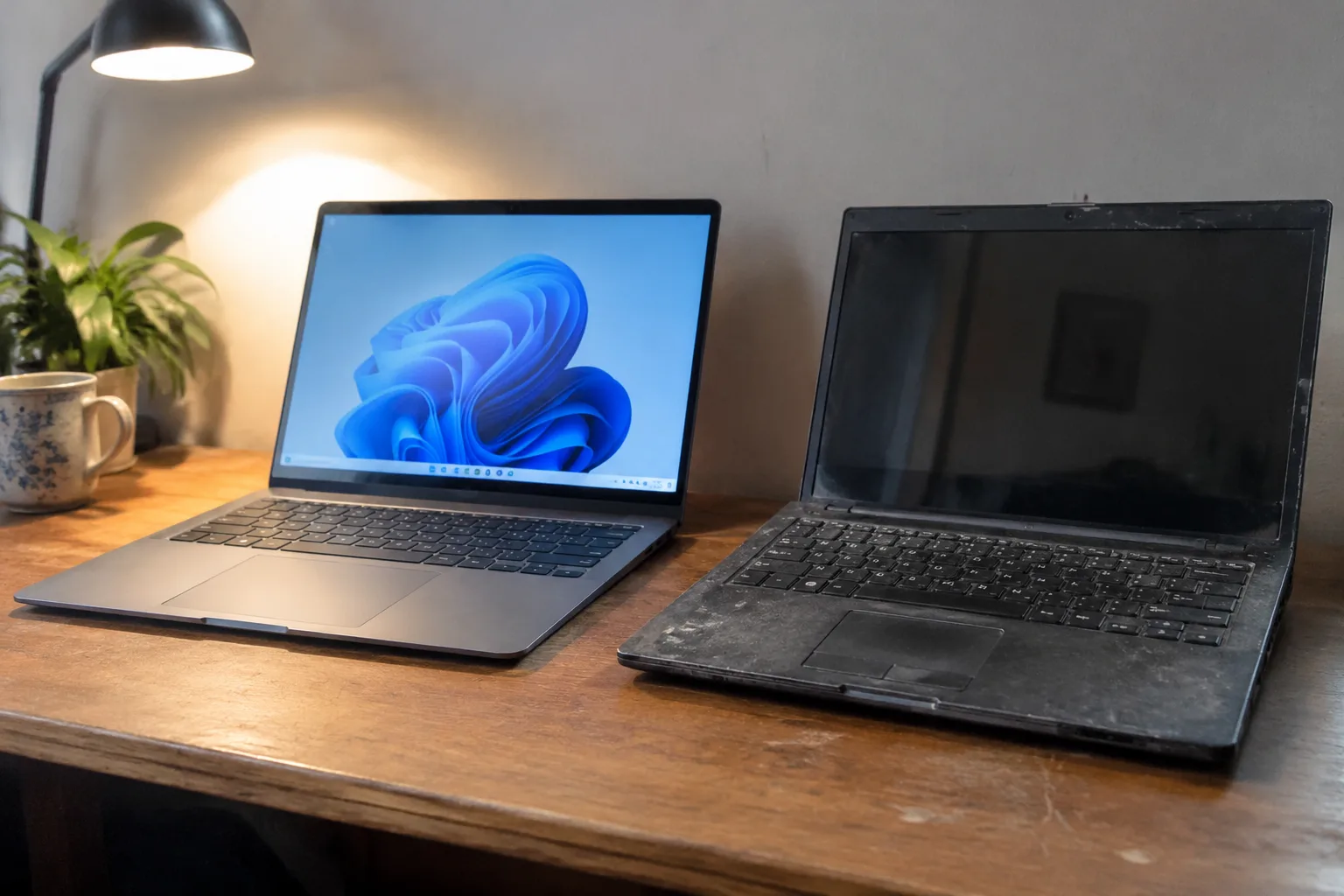
Two laptops sit on the same shelf in the same store, and one of them costs roughly half what the other does. The cheaper one has a scuff on the lid, a battery that reports 94 percent of its original capacity, and a serial number that was registered to somebody else eighteen months ago. The expensive one still has the plastic film on the palm rest. Both will run a spreadsheet, a browser with too many tabs, and a video call. The question of which is worth buying is not really a question about laptops. It is a question about what a buyer is actually paying for when the box is new.
Refurbished machines have moved from the shady corner of the market into the mainstream, and the reasons are boring and structural. Businesses lease laptops on three-year cycles and dump them by the pallet. Schools refresh fleets and sell off the old ones. Retailers take returns they cannot resell as new. All of that hardware has to go somewhere, and a lot of it goes to facilities that test it, replace worn parts, wipe the drives, and put it back on a shelf with a warranty. The category exists because the supply is enormous and the demand is real.
What "refurbished" actually covers, and where the word gets stretched
The label is doing a lot of work, and it does not mean one thing. At the strict end, a refurbished laptop has been inspected, cleaned, tested, and repaired where needed, with a fresh install of the operating system and a short warranty, often 90 days to a year. At the loose end, the word gets applied to a device that was wiped and rebooted and nothing more.
A buyer looking at a refurbished listing is really buying the seller's process, not the word on the page. A refurbisher that publishes its inspection checklist, states the battery health threshold it enforces, and backs the machine with a return window is a different animal from a marketplace seller who took a photo of a laptop on a kitchen table. The price difference between those two sellers is often small. The difference in what happens six months later is not.
The battery is the part that ages first
Every component in a laptop degrades, but they do not degrade at the same rate. The screen will look the same in year three as it did in year one. The hinges will loosen a little. The storage drive will either work or fail outright. The battery, meanwhile, loses capacity steadily with every charge cycle, and it is the one part whose decline a buyer will feel every single day.
This is why battery health is the single most useful number in a refurbished listing, and why its absence is a warning. A machine reporting 90 percent or better is close to new in the way that matters most. A machine at 70 percent will still boot and run, but it will spend its afternoon looking for a wall outlet, and a replacement battery on many modern laptops means prying off a glued-down bottom panel or paying a shop to do it. A refurbisher that replaces the battery as part of the process is charging more for a reason.
Where the savings are real and where they evaporate
The math on refurbished hardware is most favorable on machines that were expensive when they were new and depreciate fast. A business-class laptop that sold for a high price three years ago, built with a metal chassis and a keyboard meant for eight-hour days, often lands at a third of its original cost. That is a genuinely good deal, because the hardware was overbuilt for office work and the wear it has seen is gentle.
The math turns ugly on cheap consumer models. A budget laptop that cost little to begin with has little room to fall, and the refurbished discount on it is often thin, maybe 15 or 20 percent. At that spread, the buyer is accepting someone else's wear and a shorter warranty to save a small amount, and the new unit on sale is frequently the better purchase. Refurbished makes sense when the original machine was good. It makes much less sense when the original machine was a compromise.
The warranty gap nobody reads closely
A new laptop typically carries a one-year manufacturer warranty, sometimes two in certain markets, and the buyer can often extend it. A refurbished machine carries whatever the seller offers, and that range is wide. Ninety days is common. A year exists but is less common. Some sellers offer nothing beyond a short return window and call the return window the warranty.
The warranty matters more than it looks on paper because the failure curve for electronics is not flat. A large share of defects show up early, which is exactly the window a 90-day warranty covers. A machine that survives its first three months tends to keep running. That is the argument for buying refurbished from a seller with a real return policy: the early-failure risk gets transferred back to the seller, and the buyer keeps the savings on the long tail.
Software support is the quiet clock ticking
A three-year-old laptop is not just three years into its hardware life. It is also three years into its software support window. Operating systems get a defined support period, and once it ends, security updates stop. A refurbished machine that is cheap because it is six years old may be a machine that stops receiving patches within a year or two of purchase.
This is the detail that separates a smart refurbished buy from a false economy. The sweet spot is usually a machine two to four years old, new enough to still be inside its support window for several more years, old enough that the depreciation has done its work. Anything older needs to be priced accordingly, and a buyer should check the support end date before committing, because it is a hard deadline that no amount of care can extend.
What the new machine buys beyond the hardware
The premium on a new laptop is not only for untouched plastic. It buys the full manufacturer warranty from day one, the latest generation of processor and ports, a battery at full capacity, and the absence of any question about what the previous owner did with it. For a buyer who needs the machine for work and cannot afford a week of downtime, that certainty has a price, and it is often worth paying.
There is also the matter of configuration. Refurbished stock is whatever came off the lease, which means a buyer takes the specs that exist rather than the specs that are wanted. A machine with 8 GB of memory and a small drive may be the only version available at the attractive price, and upgrading it later can cost more than the difference to a new unit with better specs. The refurbished market rewards flexibility and punishes pickiness.
The buyer who should walk past the refurbished shelf
Some buyers are poorly served by the category. Anyone who needs a specific configuration, anyone who cannot tolerate a return-and-replace cycle, anyone buying for a business that requires manufacturer support contracts, and anyone who wants the latest connectivity standard should look at new. The savings on refurbished hardware are real, but they are paid for in flexibility and certainty, and some buyers have less of both to spare.
The opposite buyer, the one who benefits most, is patient and specific about the model. That buyer picks a business-class machine two or three years old, confirms the battery health and the support end date, buys from a seller with a published inspection process and a return window, and treats the savings as compensation for doing a little homework. The homework is the price of admission.
A practical way to compare two specific machines
Put the two candidates side by side and compare four numbers. The first is the total price including any warranty extension. The second is the battery health percentage, or the cost of a replacement if it is not stated. The third is the support end date for the operating system. The fourth is the return window, in days, with the shipping cost of a return included.
If the refurbished machine wins on total price by a wide margin, has healthy battery, several years of support left, and a return window measured in weeks rather than days, it is the better buy. If any of those four numbers is missing or weak, the new machine earns its premium. The comparison takes ten minutes and settles most of the argument.
The scuffed laptop on the shelf is not a lesser object. It is a known quantity with a shorter clock and a smaller price, and the buyer who understands which clock is running, and how fast, gets the better end of the deal. The one who does not gets a laptop that boots fine on day one and starts hunting for outlets by month eight.