Two hundred and forty dollars buys a respectable stereo in 2024. That figure surprises people who assume the number starts with a comma. It also misleads, because the $240 stereo is one component in a chain, and the chain is where the money actually goes.
A basic home audio setup in 2024 breaks into four purchases: source, amplification, speakers, and the wire and furniture that hold it all together. Each has a floor, a sensible middle, and a ceiling that climbs without limit. The useful task is not finding the cheapest possible total. It is knowing which parts of the chain punish cheapness and which parts absorb it without complaint.
The source is not the problem anymore
Streaming killed the expensive source. A phone already owned, paired with a $20-per-month subscription to a lossless tier, delivers more music than any CD collection ever assembled. A dedicated streamer, if one is wanted, runs $100 to $150 for a Wi-Fi puck with a decent DAC inside. A turntable, for those who want physical media, starts around $150 and becomes genuinely good near $300.
This is the part of the chain where cheapness costs almost nothing. A $120 streamer and a $1,200 streamer send the same digital bits to the same DAC, and the difference lives in software polish and casework, not in sound. Money spent here is money spent on convenience.
The amplifier is where the first real decision sits
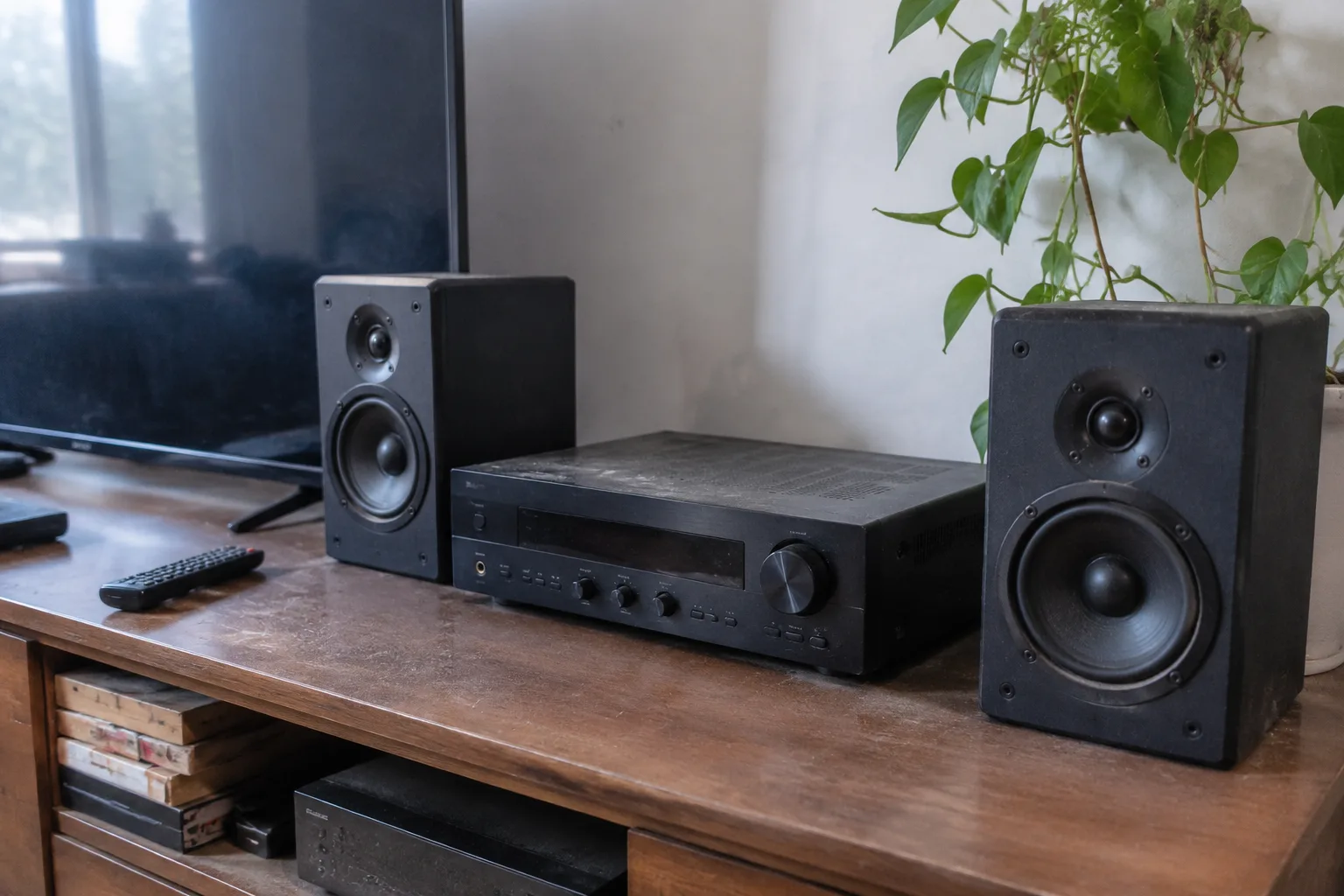
Integrated amplifiers, the boxes that combine a preamp and a power amp, start around $100 for a class-D chip amp in an aluminum case and reach $400 for the well-regarded entry models from established brands. The $100 amp is not a toy. Class-D designs from the last five years deliver clean power at efficiencies that would have been exotic a decade ago.
The jump from $100 to $400 buys inputs, a remote, a phono stage, and build quality that survives a decade of use. It does not buy a transformation in sound. A person running efficient bookshelf speakers will struggle to hear the difference between a $100 chip amp and a $400 integrated in a blind test.
The amplifier matters most when the speakers are inefficient or the room is large. A pair of small speakers in a 12-by-14-foot room asks almost nothing of an amp. A pair of floorstanders in an open living room asks a great deal.
Speakers take the largest share, and they earn it
Bookshelf speakers start near $100 a pair and become genuinely satisfying around $300. That $300 pair, from any of the half-dozen brands that dominate the budget segment, will resolve detail, image convincingly, and handle a normal living room without strain. Floorstanding speakers begin around $600 a pair and make sense in larger rooms where bass output matters.
The speaker is the transducer, the part that converts electrical signal into moving air. Every other component in the chain exists to feed it. This is why the budget should tilt heavily here: a $300 pair of speakers fed by a $100 amp will outperform a $100 pair fed by a $400 amp every time.
A subwoofer, optional in a basic setup, adds $200 to $500 and changes the character of small speakers more than any other single purchase. It also adds placement problems and neighbor problems, which is why many basic setups skip it.
The hidden line items that push the total up
Speaker wire runs $15 to $40 for a decent gauge and length. Banana plugs, optional, add $15. A stand for each bookshelf speaker runs $50 to $150 a pair, and stands matter more than people expect: a speaker on a shelf against a wall sounds muddy next to the same speaker on a proper stand pulled into the room.
Then there is the furniture problem. A basic setup needs a surface at the right height, a place to route wire, and enough distance from the rear wall for the speakers to breathe. Most living rooms offer none of this, which is why the true cost of a basic setup often includes a $100 console table or a set of wall shelves.
Add a power strip with surge protection, $25, and the small stuff accumulates to $150 or $200 before a single note plays.
Three real totals, priced out
The bare-minimum chain: a $120 streamer, a $100 chip amp, a $150 pair of bookshelf speakers, $30 of wire, and whatever surface is already in the room. Total near $400. This system plays cleanly at normal volumes and would satisfy most listeners who never heard anything better.
The sensible middle: a $150 streamer with a decent DAC, a $300 integrated amp with a phono stage, a $350 pair of bookshelf speakers, $100 of stands, $40 of wire, and a $150 console. Total near $1,100. This system handles vinyl, streaming, and a television, and it will not need replacing for a decade.
The room-filling version: a $200 streamer, a $500 integrated amp, a $700 pair of floorstanders, a $400 subwoofer, $80 of wire, and $300 of furniture and treatment. Total near $2,200. This is where a basic setup stops being basic and becomes a small hobby.
Where the money is wasted and where it is not
Expensive digital cables waste money. So do power conditioners under $500, isolation feet, and any cable priced by the meter with a name that sounds like a wine label. The physics does not support the prices, and blind tests keep confirming it.
Room treatment earns its money. A $100 pack of acoustic panels behind the speakers does more for clarity than a $300 amplifier upgrade. Placement earns its money too: moving speakers a foot further from the wall and angling them toward the listening position costs nothing and changes everything.
The single best investment in any basic setup is time spent positioning what is already owned. A $400 system placed well beats a $1,200 system shoved against a wall.
What the used market does to these numbers
Speakers depreciate like furniture and last like furniture. A pair that sold for $600 in 2015 sells for $250 today and sounds identical. Amplifiers from the 1990s, heavy and overbuilt, sell for $150 and outperform modern budget amps on power delivery. The used market cuts a basic setup's cost by 40 percent for a buyer willing to inspect foam surrounds and test every input.
The risk sits in the unknown history: a blown tweeter, a scratchy volume pot, a capacitor nearing the end of its life. A buyer who can solder and read a multimeter turns that risk into a discount. A buyer who cannot should pay the new price and keep the warranty.
The number that actually matters
Four hundred dollars gets a person into real stereo sound. Eleven hundred gets a system that lasts a decade and handles every source in the house. Two thousand two hundred fills a large room. Those are the honest figures for 2024, and none of them require a specialist dealer or a demonstration room.
The number that matters more is the one spent on the room. A basic setup in a bare room with hard floors and a glass coffee table will sound worse than a cheaper setup in a carpeted room with bookshelves and a sofa. The equipment budget is fixed and knowable; the room is where a buyer keeps spending, knowingly or not, for years after the boxes are unplugged and the receipt is filed away.