The keyboard on a laptop is a compromise in three directions at once. It has to be thin enough to fold shut, cheap enough to hit a price point, and quiet enough not to annoy the person in the next airplane seat. Every key press is a small negotiation between those constraints. A mechanical keyboard throws out the constraints and asks what a key would feel like if the only goal were the press itself. That question is worth answering for some people and a waste of money for others, and the split has less to do with enthusiasm for gadgets than with how and where a person types.
The Physical Difference Under the Keycap
Under every keycap sits a switch, and the switch decides what the finger feels. A laptop uses a scissor mechanism over a rubber dome: the key travels perhaps a millimeter and a half, bottoms out against a hard floor, and returns with a spongy push. A mechanical switch is a self-contained unit with a spring, a stem, and metal contacts, and it travels three to four millimeters with a distinct event at some point in the stroke. That event is what the finger registers: a bump, a click, or simply the crisp arrival at the bottom.
The differences come in three broad families. Linear switches drop smoothly with no bump at all. Tactile switches have a small ridge partway down that announces the actuation point without sound. Clicky switches add an audible snap on top of the bump. None of these is better in the abstract. They are different textures, the way a fountain pen and a ballpoint are different textures, and the person who prefers one can usually say why in a sentence.
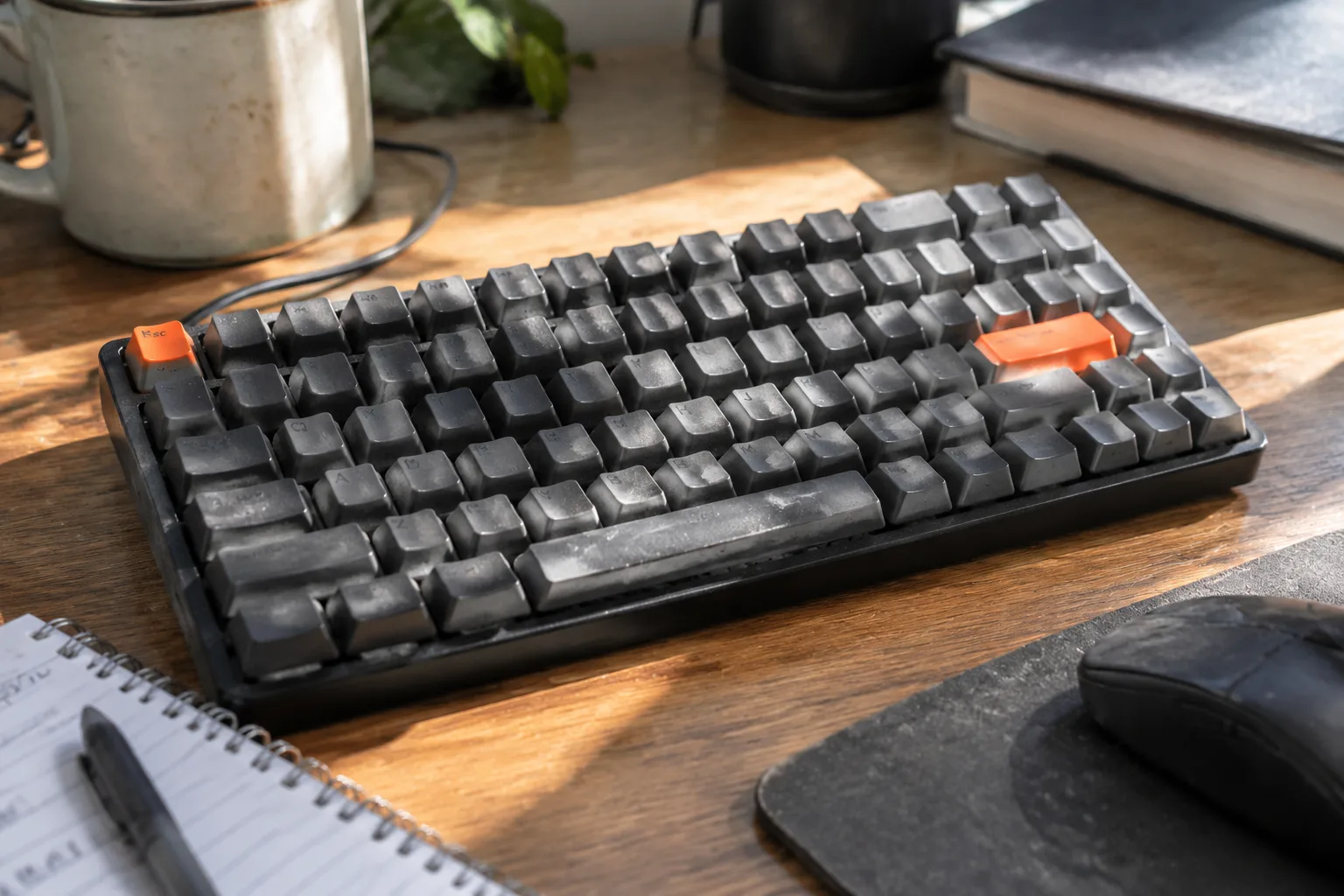
Then there is the chassis. A mechanical board sits in a case, usually aluminum or dense plastic, and the case has mass. Type on a two-pound board and the desk absorbs nothing; the board stays put while the fingers move. That stability changes the whole physical transaction. The hands stop bracing the keyboard and start just pressing keys.
Who Gets Real Value From the Switch
The clearest case is the person who types for a living and types a lot: the writer on a fourth draft, the programmer in a codebase, the person answering sixty emails before lunch. For that person the keyboard is a tool touched thousands of times a day, and small improvements in feel compound. The finger that knows exactly when a key has registered does not overshoot. The hand that is not fighting a mushy bottom does not fatigue in the same way by late afternoon. Whether that adds up to fewer errors is hard to prove, but the reduction in low-grade friction is real and noticed.
The second clear case is the person with a specific physical complaint. Wrists that ache after a long session, shoulders that creep up toward the ears, fingers that feel stiff after a day of shallow keys: these are the people for whom a different keyboard geometry can matter. A mechanical board can be had in split layouts, in tented angles, in compact sizes that bring the mouse closer to the body. The point is not that any of these fixes a medical problem. It is that the keyboard is one of the few pieces of office equipment a person can actually reconfigure to fit their hands instead of the other way around.
The third case is quieter: the person who simply likes good tools and can afford one. A mechanical keyboard is repairable in a way a laptop keyboard is not. A dead switch desolders or hot-swaps out. Keycaps wear through and get replaced. The board can outlast two or three computers. For someone who keeps a decent chef's knife and a decent pair of boots, the same logic applies here.
Who Should Walk Past the Display Case
The person who types mostly on a laptop and rarely at a desk should not buy one. A mechanical board lives on a desk. It does not travel well, it needs a flat surface, and it adds a peripheral to a bag that was already full. Buying one to use twice a week is buying a nice object to feel guilty about.
The person who shares a room, a bedroom, or an open office should think hard about noise before thinking about feel. Clicky switches are genuinely loud, and even tactile switches carry a low thock that travels. In a quiet shared space that sound becomes a social problem, and a person who buys a loud board to type at midnight has bought a fight with whoever sleeps nearby. Quiet linear switches and dampened cases exist, but they cost more and still are not silent.
Then there is the person who wants a keyboard to be invisible. Some people do not want a hobby object on the desk. They want to sit down, type, and not think about the tool. A mechanical keyboard invites thinking: about switches, about keycaps, about whether the space bar sounds right. That invitation is either the appeal or the annoyance, depending on the person, and the person who finds it an annoyance should stay with the laptop.
The Cost Curve Bends Sharply
The entry price for a decent mechanical board is lower than the hobby suggests. A solid 65 percent or 75 percent board with hot-swap sockets and reasonable stabilizers can be had for the price of a nice dinner for two. At that price the board does what it promises: it types well, it lasts, and it can be repaired.
Above that, the curve bends. Group-buy cases machined from a single block of aluminum, hand-lubed switches, custom keycap sets that take eight months to arrive: the money goes into sound, feel, and aesthetics in diminishing increments. A person can spend ten times the entry price and get a keyboard that is perhaps thirty percent nicer to use. That is a fine trade for someone who wants the object to be beautiful. It is a bad trade for someone who just wants to type.
The honest advice for a first purchase is to spend modestly, choose a switch weight and type that sounds plausible, and use the board for a month before buying anything else. Most of the hobby's expensive mistakes happen in the first two weeks, before the hands know what they actually like.
The Switch Weight Nobody Warns About
Switch weight is measured in grams of force needed to actuate, and the range runs from lighter than a laptop key to heavy enough that a full day of typing feels like grip training. A light switch, around 35 to 45 grams, suits fast typing and light fingers. A heavy switch, 60 grams and up, suits people who rest their hands on the keys and want to avoid accidental presses, and it suits the person who likes a deliberate, weighty feel. The mistake is buying heavy because it sounds serious. The hands will file the complaint within a week.
The same warning applies to keycap height. Tall sculpted caps change the angle of the finger and can be lovely or can make the top row feel like reaching over a fence. Flat caps keep the hand low. Neither is correct; both are worth trying before committing to a full set.
The Desk That Was Never Meant for It
A mechanical keyboard changes the desk around it. The board is taller than a laptop deck, so the wrists sit higher unless the chair comes up or the board sits on a tray. The mouse moves further away on a full-size board, which is why compact layouts exist: dropping the number pad buys back several inches of mouse room. The sound reflects off the desk surface, so a glass-topped desk turns a quiet board into a loud one. These are small consequences individually. Together they mean the purchase is really a purchase of a small system, and the person who ignores that will find the board feels wrong for reasons that have nothing to do with the switches.
A Reasonable Way to Decide
There is a cheap test that settles most of this. Borrow or buy one modest board, use it for a full workweek at the desk where typing actually happens, and pay attention to two things: whether the hands feel better or worse by Thursday, and whether the sound has started to bother anyone within earshot. If the hands feel better and the sound is fine, the board has earned its place. If either answer is wrong, the board goes back or goes to a friend, and the money was well spent on the information.
The people who should buy a mechanical keyboard are the ones who will notice the difference within that week and keep noticing it a year later. The people who should not are the ones for whom the keyboard is furniture. Both are reasonable positions. The only genuinely bad outcome is buying an expensive board to find out which kind of person one is, when a cheap one would have answered the same question.