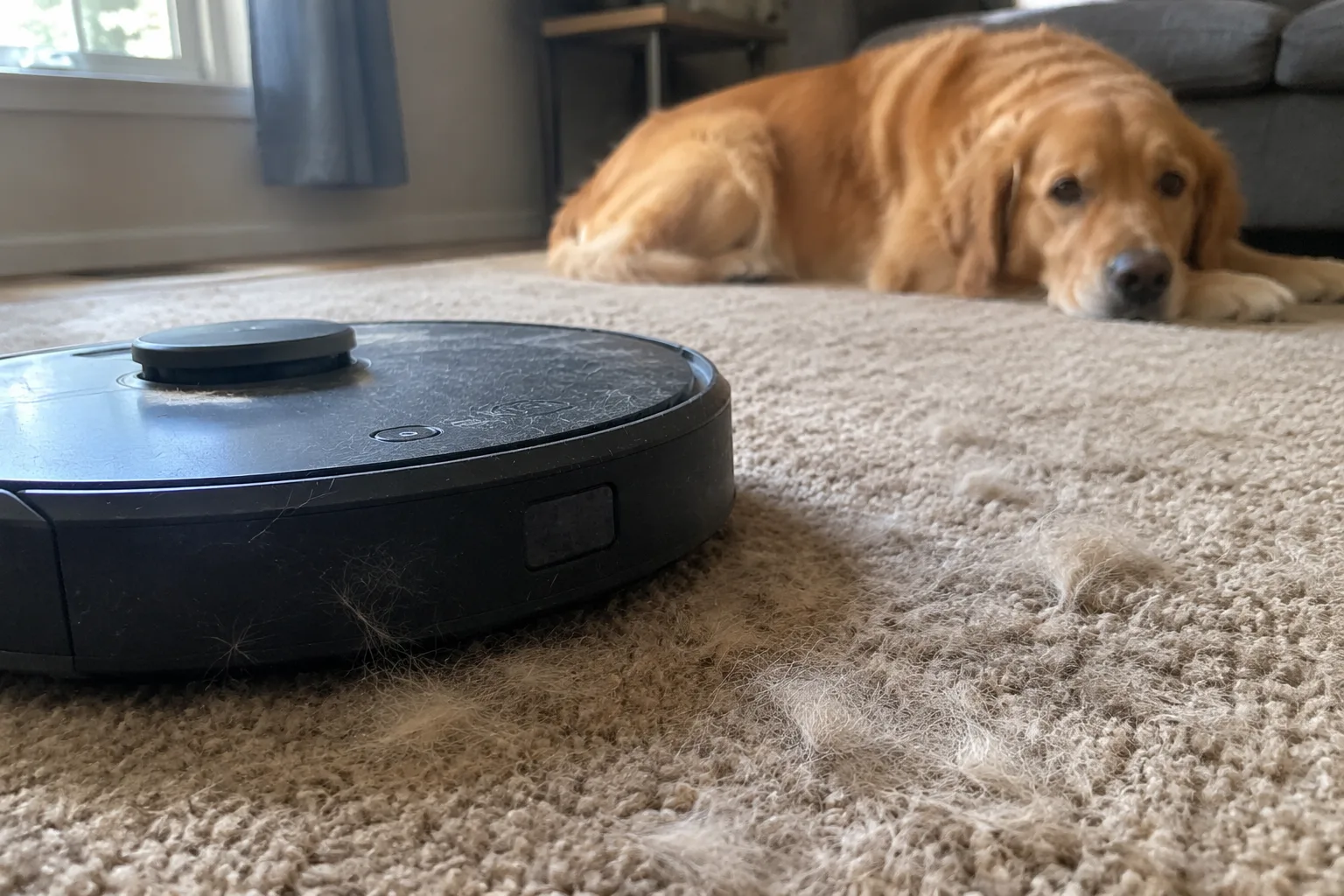
Thick carpet and pet hair are a bad pair for any vacuum, and robot vacuums feel the problem more than most. A machine that clears a bare floor in one pass can stall out on a deep pile, its brush roller winding itself into a felted sleeve of dog fur while the wheels spin and the dust bag stays empty. The category has improved enough in the last few years that a handful of models now genuinely handle both conditions, but the improvement is uneven, and the marketing rarely admits where the limits sit. What follows is an attempt to say plainly which machines cope, why the rest fail, and what a buyer gives up when a robot is asked to do the job a plug-in upright does better.
Why suction ratings tell a partial story
A vacuum's spec sheet leads with suction, usually in pascals, and the number climbs every product cycle. It matters, particularly on the dense pile of a Saxony or a frieze carpet, where air has to be pulled through a thick layer of fiber before it reaches the dirt. But suction alone does not move a robot across a deep pile. The machine also has to keep its brush in contact with the surface, and that contact is where most of the failures happen.
On a thick carpet, a robot's drive wheels can dig in and its front end can ride up, lifting the brush bar clear of the fibers it is supposed to agitate. The vacuum keeps pulling air through an empty gap. A model with strong suction but weak traction cleans the top millimeter of a carpet and leaves the grit that has settled into the base. This is why two machines with identical pascal ratings can produce visibly different results on the same rug.
Pet hair adds a second problem. Long hair and fine undercoat wrap around a rotating brush and build up until the roller stops turning, or until it turns against a solid collar of fur. A robot that lacks a way to prevent that wrap will clean well for two weeks and then clean almost nothing, and the owner often does not notice until the brush is a hard cylinder.
The brush roller question, settled
The single most useful design decision for a pet household is what spins underneath. Rubber extractors, the finned and bladed rollers used by several brands, resist hair wrap far better than conventional bristle brushes. Hair tends to slide off a rubber fin rather than weaving itself into bristles, and the fins also agitate carpet fibers without the scouring that a stiff bristle brush applies to a delicate pile.
Bristle brushes still have a place on low-pile and commercial carpet, where their stiffness lifts embedded dirt. On a thick residential carpet they tend to mat the fibers and, in a pet household, collect hair at the ends of the brush where it is hardest to remove. A machine that pairs a rubber extractor with a separate edge-cleaning brush covers more ground.
The other half of the wrap problem is the anti-tangle feature, which most brands now advertise under different names. Some use a comb or a set of tines that strip hair from the roller as it turns. Others reverse the roller briefly. The tine-and-comb approach works on long human hair and on the coarser guard hairs of a large dog. Fine cat undercoat defeats almost all of them eventually, which is why a removable roller that can be cleaned in a sink still matters.
Climbing onto a deep pile without stalling
Traction is the quiet differentiator. Wide, treaded drive wheels carry a robot over the lip of a thick carpet and keep the chassis from bottoming out. Narrow, hard wheels bog down. A few models raise their body automatically when they sense a carpet, which lifts the brush to a working height and reduces drag, but that same lift can pull the brush too far from the fibers and cut cleaning performance.
A buyer can test for this without a lab. Lay a coin or a small weight on a thick rug and let the robot pass over it. A machine with adequate ground clearance and traction will ride over the obstacle and continue. A weak one will stall, spin its wheels, or push the object around. The test is crude, but it exposes the traction and clearance that spec sheets leave out.
Transition strips and the raised edge of a carpet are the other common failure point. A robot that cannot climb a half-inch lip will clean the hard floor and abandon the rug, which is the opposite of what a thick-carpet buyer needs. Height-adjustable wheels and a front bumper that does not catch on the pile make the difference between a machine that covers the room and one that gives up at the threshold.
What the dust bin reveals after a week
The dust bin is the most honest diagnostic a pet owner has. After a week on a thick carpet, a capable robot fills its bin with a mix of grit, fine dust, and a mat of hair that has been pulled out of the pile. A machine that is failing produces a bin of surface lint and little else, because the debris that matters sits too deep for it to reach.
Bin capacity also matters more here than on hard floors. Pet hair is bulky, and a small bin fills in a single room of a shedding dog. Models with a self-emptying base solve the capacity problem by transferring debris to a larger bag or canister, which is genuinely useful in a pet household because it removes the daily chore of emptying a small bin by hand. The trade-off is the base itself: it takes floor space, it needs its own bag or canister emptied every month or two, and it adds a failure point.
The bag or canister also holds a clue. If the base fills quickly with hair and grit, the robot is reaching the carpet. If it fills slowly with dust, the machine is skimming the surface and the carpet is not being cleaned.
The models that keep their footing
Among the current generation, a few machines consistently earn their place on thick carpet in pet households. The Roborock Qrevo and its siblings pair a rubber main brush with a self-emptying dock and strong carpet detection, and their traction holds on medium and deep pile. The Shark Matrix line leans on a self-cleaning brush and a powerful suction motor, and it handles long pet hair better than most at its price. iRobot's Roomba j7 and j9 use dual rubber rollers that resist wrap and a camera-based navigation that maps carpet zones, though their bins are small enough that a self-emptying base is close to mandatory in a pet home.
Dreame and Eufy both offer models with rubber extractors and large bins at prices below the premium tier, and their carpet performance has closed much of the gap. The caveat across every brand is consistency: a model that cleans well on a medium pile can struggle on a very deep shag, and no robot currently on the market matches a plug-in upright on a thick, high-pile carpet. The honest framing is that these machines reduce the frequency of deep vacuuming, not that they replace it.
The carpet a robot cannot save
Shag and very long pile defeat the category almost entirely. The fibers are long enough to wrap around the brush and the wheels, and the pile is deep enough that the robot's chassis rides on top of it rather than settling in. A few high-end models with adjustable brush height manage a pass, but the results are modest and the risk of the machine becoming entangled is real. For a shag rug, a plug-in vacuum with a height-adjustable head remains the sensible tool.
There is also the matter of carpet condition. A thick carpet that has not been deep-cleaned in years holds a reservoir of fine grit at its base, and a robot's light pass will not extract it. The machine keeps the surface presentable while the deep dirt stays put, and the carpet wears faster as a result. A robot is a maintenance tool for a carpet that is already clean, and it works best when it is not asked to do the job of a periodic deep clean.
What to check before the return window closes
A robot vacuum is best judged in the first two weeks, while it can still go back. Run it on the thickest carpet in the house three times and inspect the brush afterward. A roller with a light dusting of hair is fine; a roller with a solid collar of fur is a machine that will fail. Check the bin for grit, not just lint. Watch whether the robot climbs the carpet edge without stalling, and whether it returns to its dock without a rescue.
The decisive test is the coin on the rug. A machine that rides over it and keeps cleaning has the traction and clearance to work a deep pile. One that stalls, spins, or pushes the coin around will do the same with the carpet's own fibers, and no amount of suction will compensate. Buy for the brush and the wheels, then for the bin, and treat the suction number as the least informative line on the box.