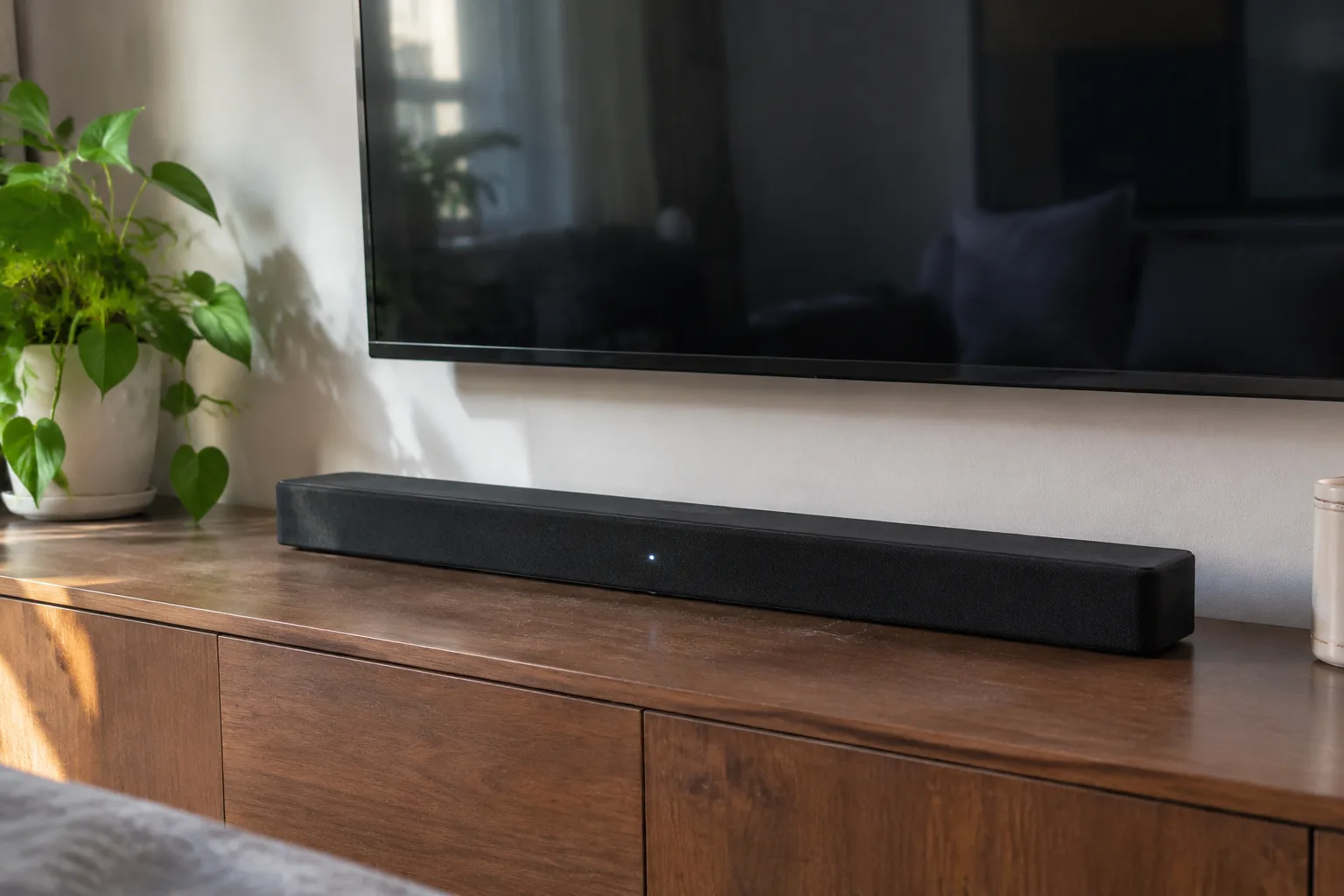
A soundbar bought for a bedroom, a study, or a small apartment living room fails in ways a soundbar bought for a big den does not. The room is the problem, and the buyer usually does not know it until the box is open and the first movie is playing. Five mistakes account for most of the disappointment, and each one is easy to make because the marketing never mentions the room.
Buying for the Size of the Room Instead of the Size of the Seat
The first mistake is choosing a bar by room dimensions. A shopper measures the wall, notes that the television is 55 inches, and buys a 42-inch bar with a wireless subwoofer because the proportions look right. Proportions are a furniture question. Sound is a distance question. What matters is how far the ears sit from the speaker and how much air the driver has to fill between the bar and that seat.
In a small room, the listening seat might be six feet from the screen. A long bar with wide-spaced drivers throws sound past the ears on both sides, and the center channel, the part that carries dialogue, arrives from two points instead of one. The result is a phantom center that wanders. Voices seem to come from slightly left, then slightly right, depending on where the actor stands on screen. Viewers describe it as "off" without being able to name it.
A shorter bar, two feet to three feet wide, keeps its drivers close enough together that the center image holds at short distance. That is the trade a small room demands, and almost no product page frames it that way.
Skipping the Room Correction Question Entirely
Small rooms are dominated by reflections. A hard floor, a bare wall behind the sofa, a television mounted against drywall: each surface bounces sound back at the listener within a few milliseconds of the direct signal. The ear fuses the two, and the result is a smeared, boomy quality that no amount of volume adjustment fixes.
Some soundbars include a calibration routine, usually a microphone on a cable or a phone app that sweeps test tones and adjusts the output. Others do not. Buyers rarely ask. They audition the bar in a store's open demo area, hear a clean, tight bass note, take it home, and get a muddy rumble because the store had absorption panels and the living room has a coffee table.
Room correction is not a luxury in small spaces. It is the difference between a bar that sounds like a bar and one that sounds like a cardboard box with a speaker inside. A buyer who cannot calibrate should at least plan for soft furnishings, a rug, curtains, a bookshelf, as part of the purchase, because those do measurable work on the reflections that ruin small-room sound.
Assuming the Subwoofer Belongs in the Corner
The subwoofer is where small-room setups go wrong most reliably. A sub placed in a corner loads the room's boundaries and produces a peak at a specific low frequency, often somewhere in the 60 to 90 Hz range, that turns every explosion and every bass guitar into a single droning note. The room is small enough that the standing wave sits right where the listener sits.
The fix is unglamorous: move the sub. A subwoofer placed a third of the way along a wall, or behind the sofa rather than beside the television, often smooths the response without any electronic correction. The common trick of placing the sub at the listening position and crawling around the floor to find where the bass sounds most even, then putting the sub there, works in small rooms because the distances are short and the experiment takes ten minutes.
Buyers who bolt the sub to the corner because that is where the outlet is have already lost the low end. The purchase was fine. The placement ruined it.
Chasing Loudness Numbers on the Box
Soundbar packaging loves a big wattage figure. Buyers compare 300 watts against 500 watts and assume the larger number means more headroom, cleaner sound at low volume, and better dynamics. In a small room, the opposite is often true.
A high-power bar in a small space tends to be driven at the bottom of its range, where the amplifier and drivers are least linear. The volume sits at 15 or 20 percent, the auto-volume and night-mode processing kicks in, and the dialogue compression that the manufacturer built in to protect the drivers flattens the quiet passages. A lower-power bar driven at 40 percent often sounds more open because the electronics are operating in their comfortable zone.
Wattage is not meaningless, but in a room where the listener sits eight feet away, a modest bar with a well-tuned crossover will beat a powerhouse that never gets out of first gear. The spec sheet rewards the wrong instinct.
Mounting the Bar Flat Against the Wall and Calling It Done
Wall mounting is the default for small rooms because floor space is scarce, and the wall mount is usually the cheapest accessory in the box. What the mount does not advertise is that a bar pressed flat to drywall reflects its own output straight back into the room, and the wall acts as a second, unwanted radiator.
Most bars are designed to sit on a shelf or a stand with a few inches of clearance behind and below the drivers. That clearance lets the mid-bass breathe and keeps the bar from coupling to the wall. A wall-mounted bar flush against the drywall often develops a hollow, boxy tone that no equalizer setting fully removes.
The compromise is a bracket that holds the bar a couple of inches off the wall, or a shelf mount that does the same job, or, simplest, leaving the bar on the console beneath the television and accepting that the television stand was always the right piece of furniture. The small-room buyer who mounts and then wonders why the sound is thin has usually created the problem in the same afternoon.
Ignoring the Dialogue Channel Because the Movie Trailer Sounded Great
Store demos run action clips. Explosions, music swells, a car chase. The bar sounds cinematic, the buyer is impressed, and the purchase is made. Then the first quiet drama arrives at home, and half the dialogue is unintelligible.
Small rooms amplify this failure because the listener sits close enough that the center channel dominates, and any weakness in the center driver, or any processing that scoops out the midrange, shows up immediately. A bar with a dedicated center channel and a dialogue-enhancement control that actually works is worth more in a bedroom than a bar with a bigger subwoofer.
The test is simple and rarely performed: bring a quiet dialogue scene, not a trailer. A scene with two people talking in a kitchen tells a buyer more about a soundbar than any explosion ever will. The small-room buyer who skips that test ends up turning on subtitles, which is the quiet admission that the purchase did not solve the problem it was meant to solve.
The Return Window Is the Only Real Audition
None of these mistakes is fatal on its own. A short bar, a sub moved out of the corner, a bracket with an inch of breathing room, a dialogue scene played before the return period closes: each corrects a specific failure that the showroom cannot reveal.
The buyers who end up happy are the ones who treat the first two weeks as an audition in their own room, with their own sofa and their own walls, and who send the bar back without sentiment if the dialogue still needs subtitles. The box goes back to the retailer. The room stays. The next bar gets chosen for the room that actually exists.