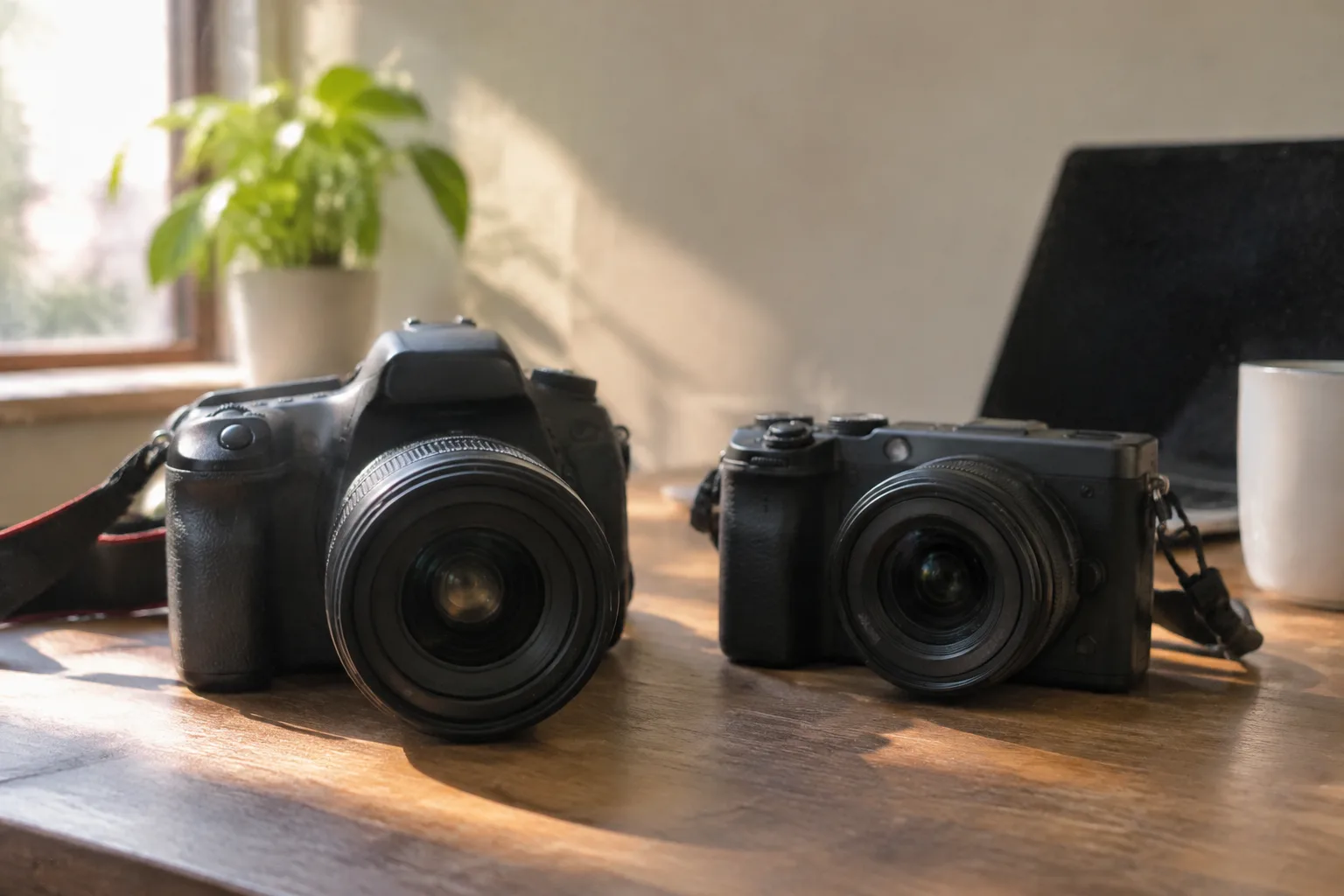
The camera shop clerk has heard the question a thousand times, and the answer has gotten messier every year. A beginner walks in with a budget of roughly 800 dollars and a vague plan to photograph a new baby, a few hikes, maybe a trip abroad. Behind the counter sit two shelves: one stacked with DSLRs that look like the cameras from magazine covers, the other with mirrorless bodies that resemble small metal bricks with a lens bolted on. The clerk knows that either shelf will produce good pictures. The clerk also knows that one of those shelves is quietly dying and the other is not, and that this fact matters less to a beginner than the internet insists.
DSLR stands for digital single-lens reflex. Inside the body, a mirror sits behind the lens and bounces light up into an optical viewfinder, flipping out of the way at the moment of exposure so the sensor can see. Mirrorless cameras remove that mirror entirely. Light hits the sensor directly, and the viewfinder becomes a tiny screen showing what the sensor sees. That is the whole mechanical difference. Everything else, the arguments, the brand loyalties, the forum wars, flows from that one piece of engineering.
What the mirror actually changes in the hand
Pick up a DSLR and the first thing a beginner notices is the weight. A Canon Rebel or a Nikon D3500 with a kit lens runs around 600 to 700 grams, and the grip is deep enough that the whole hand wraps around it. The optical viewfinder shows the world with no lag and no battery cost. Point the camera at a bird and the bird appears instantly, in real light, through real glass.
A mirrorless body of the same class, say a Sony a6100 or a Fujifilm X-T30, weighs perhaps 400 grams with a lens. The electronic viewfinder has a fraction of a second of delay in older models and almost none in newer ones. It also shows exposure preview live: turn a dial and the image in the finder brightens or darkens exactly as the photo will. That single feature converts more beginners than any spec sheet.
The DSLR viewfinder shows the scene as it is. The mirrorless viewfinder shows the scene as the photo will be. For someone learning exposure, the second is a teaching tool that never sleeps.
The autofocus gap that closed and then reversed
For years, the standard advice was that DSLRs focused faster, especially on moving subjects. Phase-detection autofocus built into a dedicated sensor gave DSLRs a real edge at tracking a running dog or a toddler crossing a lawn. Mirrorless cameras relied on contrast detection, which hunted and hesitated.
That advice is now stale. Modern mirrorless bodies use on-sensor phase detection with subject recognition, eye tracking, and animal detection, and they outperform all but the most expensive DSLRs at keeping a face sharp. A parent photographing a kid at a birthday party will get more keepers from a midrange mirrorless camera than from a comparably priced DSLR, and the camera will do more of the work.
The catch is price and generation. A brand-new mirrorless body with current autofocus costs more than a DSLR with equivalent autofocus from five years ago. The beginner buying used has to know which generation they are getting.
Battery life is the one spec that still favors the mirror
An optical viewfinder draws no power. A DSLR rated for 600 to 800 shots per charge will genuinely deliver that, and often more, because the sensor only wakes up when the shutter fires. Mirrorless cameras run a screen or an electronic finder constantly, and a rating of 300 to 400 shots is optimistic in cold weather or during a long day of chimping at the back screen.
For a weekend photographer this hardly matters. For someone planning a multi-day trek with no outlet, it means carrying two or three spare batteries, which erodes the weight advantage mirrorless supposedly offers. A DSLR and one battery versus a mirrorless and three batteries is close to a wash in the bag.
The lens mount is the decision that outlasts the body
Camera bodies age in four or five years. Lenses can serve for twenty. The beginner who buys a DSLR today is buying into mounts that the major manufacturers have stopped developing: Canon's EF mount and Nikon's F mount still have vast used markets, but new lens releases have dried up. That is not a disaster. It means excellent glass at low prices, and a huge supply of secondhand primes and zooms.
The beginner who buys mirrorless is buying into mounts still being actively built out, with new lenses arriving each year and prices that have not yet fallen. Canon RF, Nikon Z, Sony E, Fujifilm X. The long game favors these mounts; the short game favors the used DSLR shelf.
There is a middle path worth naming: a mirrorless body with an adapter for old DSLR lenses. Adapters work well for most situations, cost 100 to 300 dollars, and let a beginner use cheap used glass while keeping the newer body. Autofocus slows slightly with some combinations and video autofocus can get fussy, but for stills it is a practical bridge.
Video, where the mirror becomes dead weight
Anyone who wants to shoot video should look hard at mirrorless. The mirror in a DSLR has to lock up during video recording, which means the optical viewfinder goes dark and the camera must use its rear screen in a clunky live-view mode. Autofocus during DSLR video is slow and noisy on most models.
Mirrorless cameras were built for video from the start. They autofocus smoothly, track faces, and offer features like focus peaking and zebra stripes that help a beginner avoid blown highlights. A parent who wants short clips of a first steps moment will find the mirrorless experience dramatically less frustrating.
What the used market quietly offers a beginner
A used DSLR from the past decade is one of the best value propositions in photography. A Nikon D5300 with a kit lens can be found for 250 to 350 dollars. A Canon Rebel T7i similar. These cameras produce files indistinguishable from new ones at normal viewing sizes, and the lens ecosystem around them is deep and cheap.
The used mirrorless market is thinner and pricier. Early Sony a6000 bodies hold value stubbornly, and Fujifilm cameras have a cult following that keeps prices high. A beginner on a tight budget will get more camera for the money on the DSLR side, and that camera will still take excellent photos.
The risk with used gear is the same on both shelves: shutter count, sensor dust, and hidden damage. Buying from a reputable dealer with a return window matters more than the DSLR versus mirrorless question at this price point.
The size question that determines whether the camera leaves the house
The best camera is the one carried. A DSLR with a zoom lens is a committed object, roughly the size and weight of a hardcover book, and it demands a bag. A mirrorless body with a small prime lens can slip into a jacket pocket or a tote. That difference decides, for many beginners, whether the camera comes on a walk or stays on a shelf.
This is where the honest recommendation for most beginners lands. If the camera will mostly sit at home and come out for holidays, the DSLR's price advantage and battery life win. If the camera is meant to travel everywhere, the mirrorless size advantage wins, and the beginner will take more photos, which is the only metric that matters for learning.
A concrete way to decide in one afternoon
Walk into a shop and hold both. Not for a minute. For fifteen. Mount a lens, raise the camera to the eye, and shoot a few frames with each finder. The optical finder will feel like looking through a window; the electronic finder will feel like looking at a small television. Some people love the television; some find it faintly nauseating. That reaction is personal and no spec sheet predicts it.
Then check the lenses on the shelf. If the shop has a wall of used DSLR glass at 80 dollars a prime, that is a real advantage for a beginner building a kit on a budget. If the shop has three mirrorless lenses and all of them cost 400 dollars, the beginner should know that going in.
Finally, list the actual subjects. Kids and pets and sports push toward modern mirrorless autofocus. Landscapes and portraits and travel push toward whichever body feels right in the hand, because both will do the job. The subject list, not the technology, should decide.
The beginner who buys a DSLR in 2025 is not making a mistake
The internet has largely declared the DSLR dead, and the declaration is premature for anyone shopping on a budget. A used DSLR with a 35mm equivalent prime lens will teach exposure, composition, and light as well as any mirrorless body, and it will cost a third as much. The photos will be indistinguishable at print sizes most people actually use.
The camera that gets carried, understood, and used is the right camera. A beginner who buys a 300 dollar used DSLR and shoots ten thousand frames will learn more than one who buys a 1,200 dollar mirrorless body and shoots two hundred. The mirror inside the camera is a mechanical detail. The habit of carrying it is the whole game.