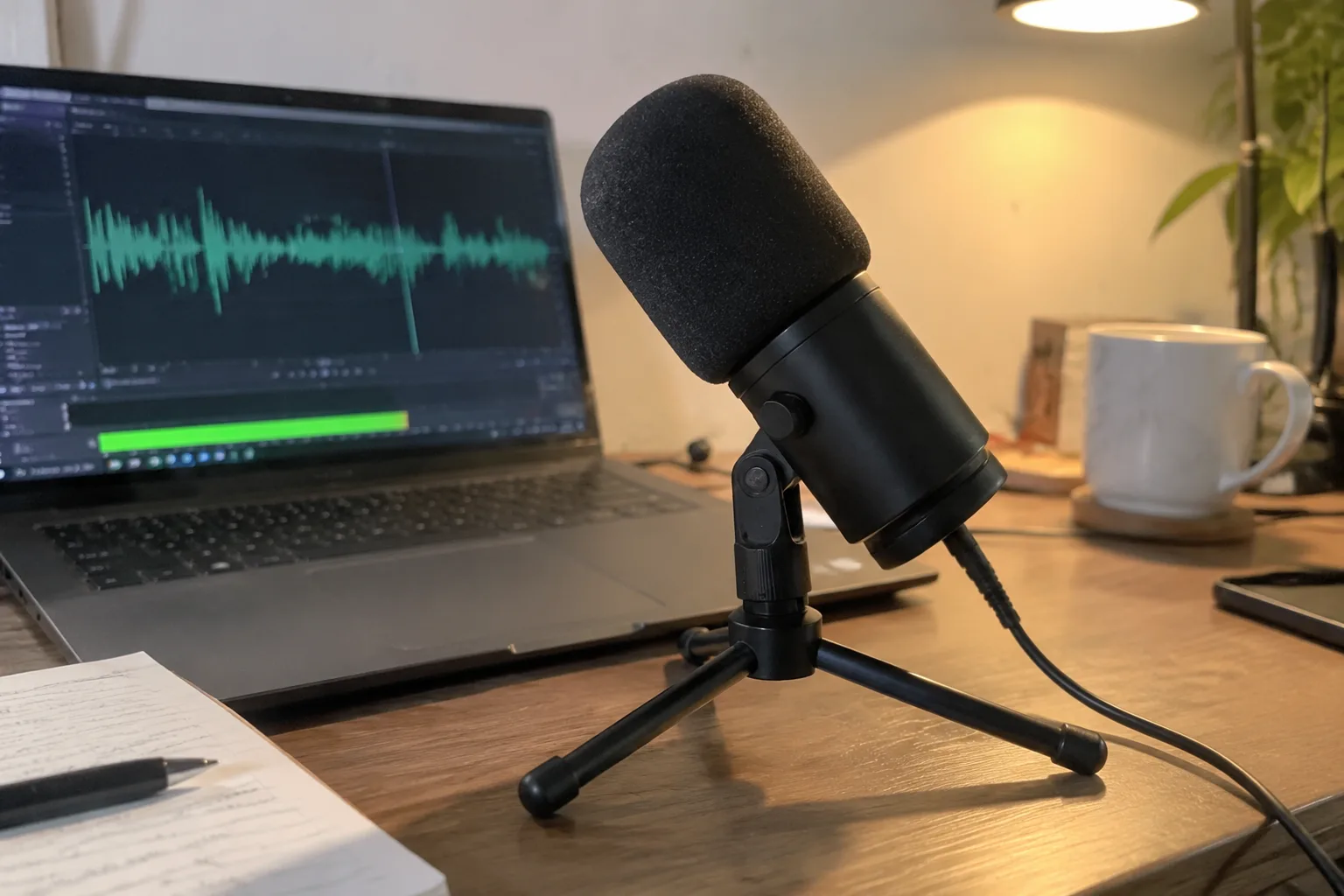
A microphone costs ninety dollars. The podcast it records can sound like a phone call from a parking garage or like a voice sitting across a kitchen table. That gap is almost never the microphone's price. It is the microphone's type, its placement, and the acoustics of the room it sits in. A person can spend three hundred dollars on a condenser and make it sound worse than a sixty-dollar dynamic, because the condenser will faithfully capture the refrigerator hum and the bare walls and the neighbor's television through the shared wall.
The budget bracket for home podcasting runs roughly fifty to two hundred dollars. Above that, returns shrink fast. Below it, the useful options start to thin out. The interesting decisions happen in between, where the tradeoffs are real and the wrong pick is genuinely the wrong pick for a given room.
Two Families of Microphone and Why the Room Decides First
Dynamic microphones ignore most of the room. They are built to be held close, to reject sound arriving from the sides and rear, and to stay forgiving when a person leans in or turns away mid-sentence. Condenser microphones pick up more detail, more air, more nuance, and also more of everything else. In a treated room, that detail is a gift. In an untreated bedroom with a heating vent and a hard floor, it is a liability.
Most home podcast setups are untreated bedrooms, closets, or kitchen tables. That single fact should push the vast majority of first-time buyers toward a dynamic microphone. The condenser is the instrument of a studio. The dynamic is the instrument of a spare room with a duvet hanging behind the chair.
There is a second decision buried inside the first: USB or XLR. USB microphones plug straight into a laptop and carry the preamp and converter inside the body. XLR microphones need an audio interface, which adds roughly a hundred dollars to the bill. The USB path gets a person recording in ten minutes. The XLR path gets a person a system that upgrades cleanly and rarely needs replacing.
The Shure MV7 and the Cost of Buying Once
The Shure MV7 sits around two hundred and fifty dollars new and can usually be found closer to two hundred on sale. It is the top of the "budget" bracket and the bottom of the "professional" one, and it is the microphone that most often ends the search. It is a dynamic capsule, it has both USB and XLR outputs, and its companion app applies a voice-focused processing that makes a raw recording sound finished without any editing skill.
That price is not trivial. But the MV7 has a property that cheaper microphones lack: it does not become the weak link. A person who buys one and later adds an interface, a boom arm, and a treated corner has not wasted the purchase. The microphone was never the problem. The rest of the chain catches up to it.
The argument against it is simple arithmetic. Two hundred and fifty dollars is a lot to spend before knowing whether the podcast will last three episodes. The argument for it is that a bad-sounding first season is the most common reason a podcast does not last three episodes.
The Samson Q2U and the Case for Spending Sixty Dollars First
The Samson Q2U costs around seventy dollars and does the two things a beginner actually needs. It is a dynamic microphone, so it tolerates a bad room. It has both USB and XLR, so it does not become e-waste the moment a person outgrows it. It also has a headphone jack for direct monitoring, which matters more than it sounds: hearing a voice in real time is how a person learns to stop popping plosives and drifting off-axis.
The Q2U does not sound like the MV7. Its capsule is less refined, its handling noise is worse, and its USB output is more prone to a faint hiss at high gain. But it sounds like a podcast. A person who records on a Q2U in a quiet room with a blanket behind the chair will produce something that clears the bar of "sounds intentional."
Seventy dollars to test the whole enterprise is a reasonable bet. The microphone can be resold, kept as a backup, or handed to a guest. The real cost of starting small is not the money. It is the small chance that the cheap microphone becomes an excuse to stop.
The Audio-Technica ATR2100x and the Middle Lane
The ATR2100x sits at roughly a hundred dollars and occupies the same conceptual territory as the Q2U: dynamic capsule, USB and XLR, headphone monitoring. It is a slightly better-built version of the same idea, with a metal body and a cleaner gain structure. The difference between the two is small enough that the choice mostly comes down to availability and price on a given week.
What makes this tier interesting is that it removes the false choice between "cheap and disposable" and "expensive and permanent." A hundred dollars buys a microphone that will survive a desk knock, a backpack, and a year of weekly recording. It is the sensible default for someone who is fairly sure the podcast will continue but not yet sure it will justify a studio.
The Fifine K669 and the Honest Ceiling of Thirty Dollars
Below seventy dollars, the field narrows to a handful of USB condensers, and the Fifine K669 at around thirty-five dollars is the most common entry point. It is a small metal-bodied condenser with a single USB output and a gain knob. It sounds better than a laptop's built-in microphone by a wide margin. It sounds worse than a phone held close to the mouth in a quiet room, which is a useful benchmark for what the bottom of the market actually delivers.
The K669 is a condenser, so it hears the room. Its pickup pattern is cardioid, but its self-noise is audible at normal speaking volume, and it has no headphone jack. The result is a recording that sounds thin and a little distant, with a faint background hiss that becomes obvious once compression is applied.
This is not a reason to avoid it. It is a reason to understand what thirty-five dollars buys: a way to record a first draft, a tool for a guest interview that will not be published, a microphone for a video call. The K669 is honest about its place. It is the microphone someone buys to find out whether the idea is worth a better one.
What the Microphone Cannot Fix
No microphone in this bracket rescues a room with a hard floor, a bare wall, and a window facing a street. The single most effective upgrade for home podcast audio costs nothing: hang a duvet or a heavy blanket behind the recording chair, sit with a wall or a bookshelf in front, and put a rug underfoot. The difference between a raw recording in a bare room and the same microphone in a softened corner is larger than the difference between a Q2U and an MV7.
Microphone placement is the second free upgrade. A dynamic microphone wants to sit two to four inches from the mouth, slightly off-axis so the breath does not hit the capsule directly. A person who speaks across the capsule rather than into it removes most plosives and much of the sibilance before any editing software is opened. A foam windscreen helps. A pop filter helps more. Neither costs much.
The third free upgrade is a boom arm. A microphone on a desk stand picks up every keyboard clack and every knuckle tap through the desk surface. An arm isolates the microphone from the desk and puts it at mouth height, which is where it needs to be. A basic arm runs twenty to thirty dollars and does more for a recording than a hundred dollars of extra microphone budget spent on a desk stand.
The Case for One Good Microphone and a Cheap Everything Else
The budget for a home podcast is not really a microphone budget. It is a chain budget, and the microphone is one link. A person with two hundred and fifty dollars to spend has two coherent plans. The first is to spend it all on an MV7 and use a desk stand and a bare room. The second is to spend seventy on a Q2U, forty on a boom arm and a pop filter, and the rest on a used interface for later.
The second plan sounds better on day one. It also sounds better on day one hundred, because the arm and the treated corner and the placement habits are what separate a recording that sounds like a podcast from one that sounds like a microphone test. The microphone matters. The chain around it matters more.
There is a version of this advice that ends with a spreadsheet. The better version ends with a single observation: the microphones in this bracket are all competent. The ones that fail do so because they are the wrong type for the room, or because they are paired with a desk stand and a bare wall. A person who picks a dynamic microphone, hangs a blanket, buys an arm, and speaks across the capsule will get a usable recording out of any of the models above. The microphone is the least interesting decision in the chain, and the most common one to overthink.