The laptop's built-in microphone sits about eighteen inches from a face, pointed at a hinge, and collects everything the room has to offer: the refrigerator cycling on, a neighbor's leaf blower, the clack of a mechanical keyboard. On the other end of the call, the voice arrives thin and slightly hollow, with a persistent hiss underneath it. That is the ordinary condition of remote work audio, and most people have decided it is good enough. The question is whether that judgment holds up once a person starts spending two or three hours a day on camera.
A dedicated microphone does not transform a voice. It moves the microphone closer to the mouth, narrows what it hears, and passes a fuller signal to the far end. Those three changes do real work, and whether they matter depends entirely on what the calls are for. A quick stand-up at 9:15 does not need studio sound. A client presentation, a job interview, a recorded onboarding session, a weekly one-on-one with a manager who is hard of hearing: each of those raises the stakes, and the built-in mic starts to show its seams.
What the laptop microphone actually captures
Laptop microphones are marvels of miniaturization and compromise. They sit behind a grille the size of a grain of rice, often in an array of two or three elements, and they rely on software beamforming to figure out which direction the voice is coming from. That processing works best in a quiet room with a single talker. Add a second person in the room, a fan, or a hard bare wall six feet away, and the beamformer starts making guesses. The result is a voice that sounds distant and a room that sounds present.
The distance itself is the core problem. Sound energy falls off with the square of distance, so a microphone at eighteen inches receives roughly a ninth of the energy it would at six inches. The preamp has to work harder, which lifts the noise floor along with the voice. Every one of those tradeoffs shows up on the far end as a voice that tires the listener, even if nobody can name why.
The case for a cheap USB mic on a desk stand
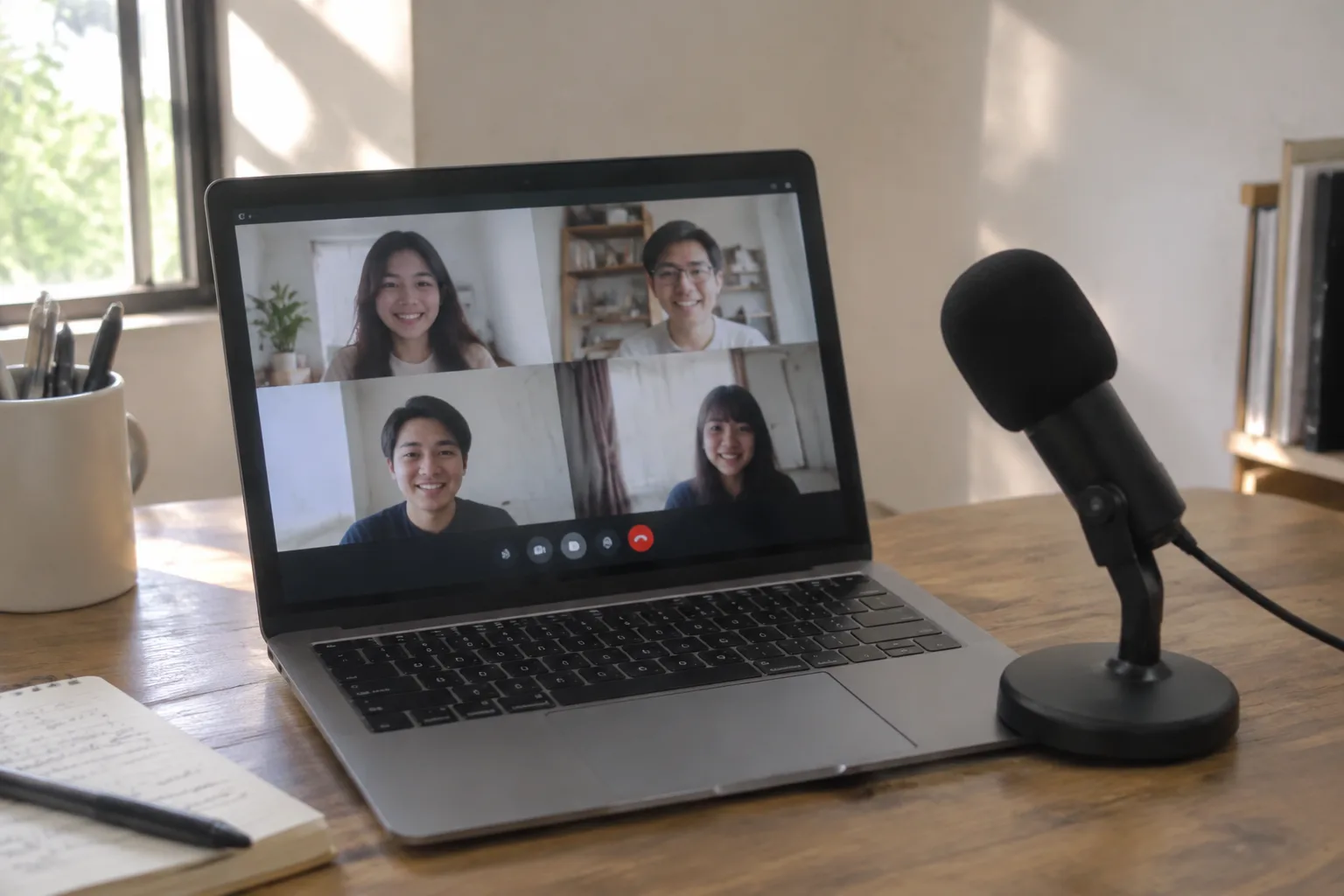
There is a category of microphone that costs less than a nice dinner and solves most of the problem: the small USB condenser on a short stand, placed between the keyboard and the monitor, aimed at the chin. Pop it on a desk, speak toward it from eight to ten inches away, and the voice arrives with body and presence. The room recedes because the microphone is no longer listening to the whole room. The hiss drops because the preamp is not straining.
These microphones are not elegant. Many have a cardioid pattern that is forgiving but not precise, a plastic body that picks up desk bumps, and a fixed gain that clips if a person laughs too close to it. None of that matters on a video call. The far end hears a voice that sounds like a person in a room rather than a person at the bottom of a stairwell, and that is the entire job.
The one accessory that matters more than the microphone itself is a boom arm or a short riser that gets the capsule off the desk surface. A microphone sitting directly on a hard desk transmits every keystroke and every coffee mug set down as a low thud. A ten dollar foam windscreen and a five dollar riser solve most of it. Anyone who has listened to a colleague type through a desk-mounted mic knows the sound: a dull, rhythmic knocking underneath every sentence.
Where the built-in mic genuinely holds its own
There is a real argument for leaving the laptop microphone alone, and it is stronger than the audio hobbyists admit. Modern laptops from the major manufacturers have gotten genuinely good at voice isolation. Apple's MacBooks, recent ThinkPads, and the better Surface models run array processing that suppresses a barking dog or a nearby conversation with surprising effectiveness. In a quiet room, on a call where the voice is the only thing that matters, the gap between built-in and dedicated narrows to something most listeners cannot reliably identify.
Portability is the other half of the case. A person who works from a kitchen table, a coworking space, and a hotel room three days a week does not want to carry a microphone, a stand, and a cable in addition to a laptop and a charger. The built-in mic is always there, always aimed roughly at the face, and never needs to be plugged in. For the nomadic worker, that reliability is worth more than a marginal improvement in timbre.
Then there is the social cost. A conspicuous microphone on a boom arm, swung into frame like a radio host's, changes how a person is perceived on a call. In some rooms that reads as professionalism. In a casual team meeting, it can read as a hobbyhorse. Plenty of people have quietly decided the audio improvement is not worth the visual announcement.
The listener on the other end is doing the real work
Here is the part of the debate that rarely gets stated plainly: the cost of bad audio is paid by the people listening, not the person speaking. A voice that arrives thin and roomy forces every listener to spend a little more cognitive effort parsing it. Over a forty-five minute call, that effort accumulates. Listeners get tired. They miss words. They ask for repeats. The speaker, hearing their own voice through their own skull, has no idea any of this is happening.
This asymmetry is why audio quality matters more than video quality on most calls. A slightly soft webcam image is a minor annoyance. A voice that sounds like it is coming from another room is a sustained tax on everyone else's attention. People who invest in a ring light and ignore their microphone have optimized the wrong variable, and their colleagues know it even if nobody says so.
When the upgrade pays for itself in a single call
Certain situations make the decision for a person. A job interview conducted over video is a performance, and the interviewer is forming an impression in the first thirty seconds. A voice that sounds clear and close reads as composed and prepared. A voice that sounds distant and echoey reads as distracted, fairly or not. The microphone is doing work that has nothing to do with audio engineering.
Recording is the other clear case. Anyone who records presentations, training videos, podcast episodes, or async video updates for a distributed team is producing a file that will be listened to without the benefit of a live conversation. There is no back-and-forth to paper over a muddy signal. The recording either sounds clean or it does not, and the difference is audible on a phone speaker in a car.
People with softer voices, or who work in rooms with hard floors and bare walls, get more out of a dedicated mic than the average user. A carpeted room with bookshelves and a couch absorbs reflections, which flatters a laptop mic. A glass-and-concrete apartment with a hardwood floor turns every sentence into a small concert hall. The microphone placement matters more than the microphone itself, but a close mic in a bad room beats a distant mic in a bad room every time.
The honest middle path for most desks
For the person who takes a lot of video calls from a fixed desk, the practical answer is a modest USB microphone in the forty to eighty dollar range, on a short stand or a cheap boom arm, positioned eight to ten inches from the mouth and slightly off-axis to avoid plosives. That setup costs less than a decent office chair and lasts for years. It does not need to be a broadcast condenser with an audio interface and a shock mount. It needs to be close and pointed at a face.
For the person who is rarely at the same desk twice, the built-in mic is fine, and the better investment is a pair of wired earbuds with an inline microphone. The earbud mic sits near the mouth, rejects the room, and costs almost nothing. It sounds noticeably better than the laptop array on a call, and it fits in a pocket. The dedicated desktop microphone is a tool for a fixed location, and pretending otherwise is how people end up with a drawer full of gear they never use.
The question in the title has a conditional answer, which is unsatisfying but true. A dedicated microphone is worth it for the person whose voice is the product on the call, who sits in one place, and who can spare eighty dollars and four inches of desk space. For everyone else, the laptop microphone and a pair of earbuds will carry the day. The far end will hear a voice, and the voice will sound like a person, and that is the whole of the matter.