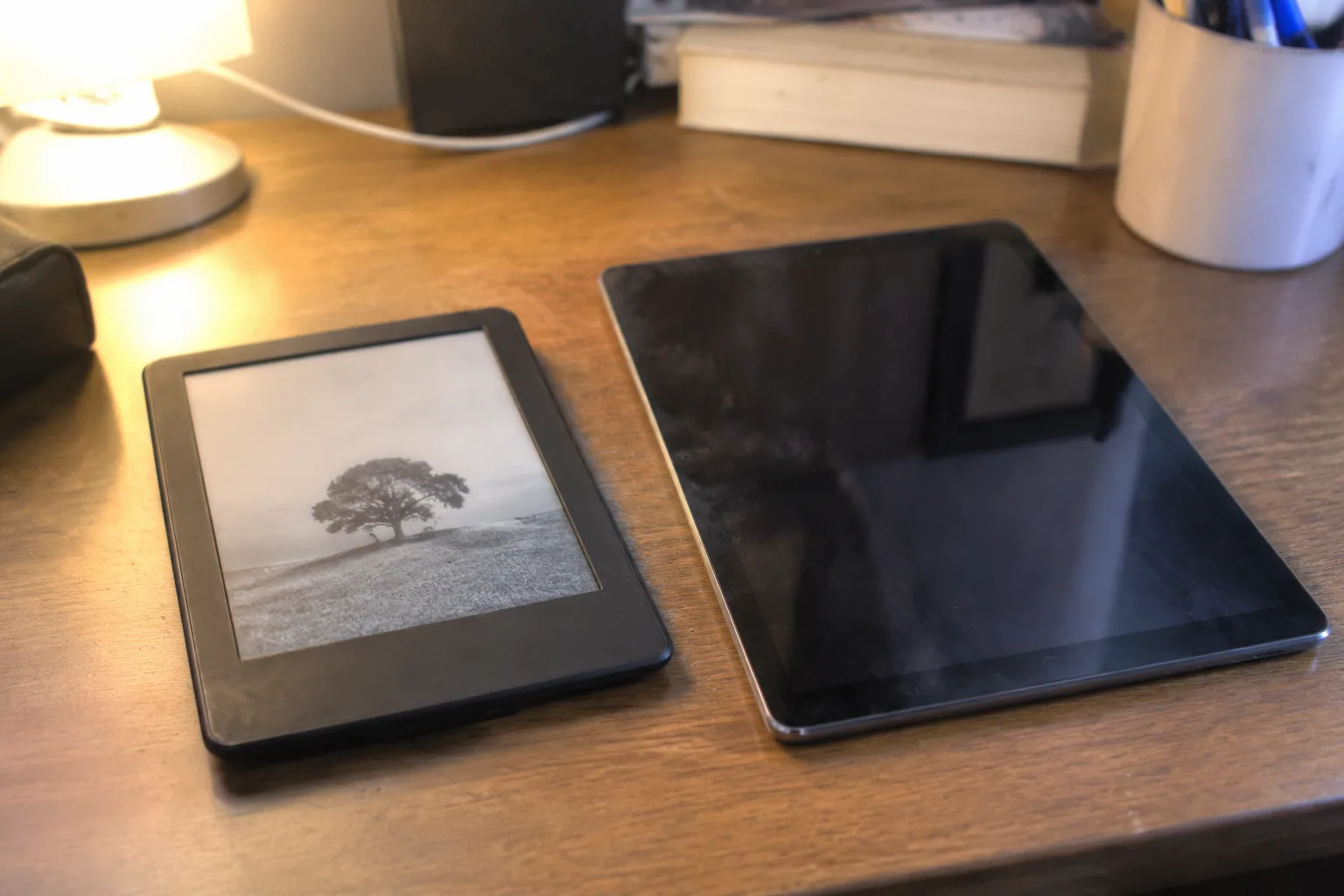
A dedicated e-reader is a single-purpose machine, and that is the whole of its case. It weighs less than a paperback, holds a charge for weeks, and its screen reflects light the way paper does, so the text sits on the surface rather than glowing up through it. A tablet does nearly everything else better, but it does not do the one thing the e-reader was built for: get out of the way while a person reads a book.
The question of who should buy which one sounds like a spec comparison. It is closer to a question about habits. The right device depends on what a person is trying to protect from their own attention, and on where and when they read.
The Screen That Refuses to Sparkle
E-ink displays do not emit light the way phone and tablet screens do. They hold an image in place using tiny charged particles, consuming power only when the page turns. In daylight, the screen looks like a page of newsprint, slightly grey, faintly matte, with no glare to fight. Under a lamp at night, a front light washes across the surface from the edges rather than shining into the eyes.
That difference is physical, not philosophical. A backlit tablet is a small window aimed at the face. An e-ink screen is a surface that happens to have words on it. People who read for hours report the distinction in their eyes and their sleep, though it is the kind of thing that resists a chart.
The tradeoff is speed and color. Pages refresh with a brief flicker. Covers arrive in greyscale. Comics and cookbooks look like washed-out proofs. Anyone who wants to page through a magazine with photographs, or read a graphic novel with saturated ink, will find the device maddening.
A Battery Measured in Weeks, Not Hours
An e-reader left in a bag for a month will usually still open to the last page read. A tablet left in a bag for a month will be dead, and the person who owns it will spend the first ten minutes of a flight hunting for an outlet. That single fact reshapes how the device gets carried. It can live in a coat pocket or a glovebox without a charging ritual.
The consequence is subtle but real. A device that never needs charging is a device that can be forgotten and then found again. A device that needs a nightly cable becomes part of the household's electrical chore list, another thing to remember beside the phone and the watch.
The Reader Who Cannot Stop Checking Messages
This is the strongest case for the dedicated device, and it has almost nothing to do with hardware. A tablet is a doorway to everything else: mail, notifications, a browser tab left open on a news site, a game that buzzes at the wrong moment. A chapter gets interrupted, then another. The book loses.
An e-reader has no such door. Some models carry a browser, and it is slow enough to be self-defeating. The absence of distraction is the feature. A person who reads on a tablet and finds the page count flat-lining after twenty minutes is a person the e-reader was invented for.
There is a version of this reader who does not realize the problem is the device. They blame their own attention span, buy another novel, and stall again. Handing them a single-purpose screen often fixes a problem they had misdiagnosed as a character flaw.
Long Flights, Thin Margins, and a Coat Pocket
Travel is where the smallness pays off. A paperback plus a tablet plus a charger is a small bag's worth of weight. An e-reader the size of a thin notebook slides into an inner pocket and carries a hundred books without complaint.
The math of a long trip is unglamorous. A coast-to-coast flight is five or six hours. A transatlantic haul is closer to nine. A tablet asked to run a video, a book, and a map for that long will need a charge before landing. An e-reader will not. For the traveler who reads in airport queues, on trains, and in the strange hours when the cabin lights are dimmed, the dedicated device earns its place.
When a Library Card Becomes the Buying Decision
Public library lending has become the quiet argument for a dedicated e-reader. Most library systems in the United States and much of Europe lend ebooks through apps that run on phones and tablets. Those apps work, but they compete with everything else on the device. On a dedicated reader, the borrowed book opens to a clean page.
For a heavy library user, the device pays for itself in convenience long before it pays for itself in book purchases. The person who borrows a dozen titles a month and reads them in bed, on the bus, and at lunch is a natural fit. The person who reads four books a year and buys them in hardcover is not.
The Tablet Wins for Almost Everything Else
A tablet handles PDFs, textbooks, and anything with a chart or a figure far better than an e-reader does. The larger screen and the pinch-to-zoom gestures make a dense academic paper legible. E-ink readers choke on the same document, shrinking the type to a grey blur or forcing an awkward reflow that scatters the footnotes.
Comics, magazines, and children's picture books belong on a tablet. So does anything that needs color to make sense, from a birding guide to a knitting pattern. A person whose reading life is mostly visual is not the e-reader customer, no matter how much they like the idea of one.
Single-device households also tilt toward the tablet. One screen that does email, video, and books is a better value than two screens that each do less. The dedicated reader makes sense when it is an addition, a second device with a narrow job.
The Person Who Reads in Bed at Eleven at Night
Late-night reading is its own case. A tablet at full brightness in a dark bedroom lights up the whole room and keeps the brain humming. An e-reader with the front light turned low casts a soft glow on the page and little else. The difference in how a person falls asleep afterward is the sort of thing readers swear by.
There is also the matter of a partner trying to sleep. An e-reader turned dim is quieter to the eye across the room than a tablet's bright rectangle. Small domestic details like this rarely make it into a spec sheet, and they are often the reason a device stays in use.
Waterproofing, Sand, and the Bathtub
Many e-readers are now built to survive a dunking. A reader who likes to soak in the tub with a book, or read beside a pool, or take a device to the beach, will find that a mid-range e-reader tolerates the water and the grit better than most tablets. Sand in a tablet's speaker grille is a repair. Sand on an e-reader wipes off.
This is a narrow use, but it is a real one. The person who reads in the bath has probably already ruined a paperback or two. The waterproof e-reader is, for them, a solved problem.
What the E-Reader Cannot Do
Honesty about the limits matters more than praise. An e-reader is poor for note-taking, poor for highlighting with a finger, and poor for looking things up mid-sentence. Footnotes and endnotes work, but slowly. A reader who marks up books, keeps a commonplace notebook, or flips back and forth to a glossary will feel the friction.
The device is also a poor fit for anyone who reads mostly on a phone. The phone is always there, and a reader who has trained themselves to read in short bursts on a small screen may find the e-reader an unnecessary third object. The dedicated device rewards long, uninterrupted sessions, not stolen paragraphs in a checkout line.
The Buyer Who Should Walk Past the Display
The person who should not buy one is easy to describe. They read a handful of books a year, mostly in PDF, mostly with color figures. They take notes in the margins. They read on a phone already and like it. They want one device that does everything. For them, the e-reader is a drawer appliance, charged once, used twice, then forgotten beside the spare cables.
The person who should buy one is equally easy to describe. They read most nights. They finish books and start new ones within the week. They have a library card and use it. They travel and hate chargers. They lose twenty minutes to notifications every time they open a tablet to read. They want a screen that does one thing.
The purchase decision, in the end, is a decision about what a person wants their reading time to look like. A tablet is a room with the television on in the corner. An e-reader is a room with a lamp and a chair. The buyer who wants the second room, and can name the reasons, should buy the second room. The buyer who wants the first should keep the tablet and stop feeling guilty about it.