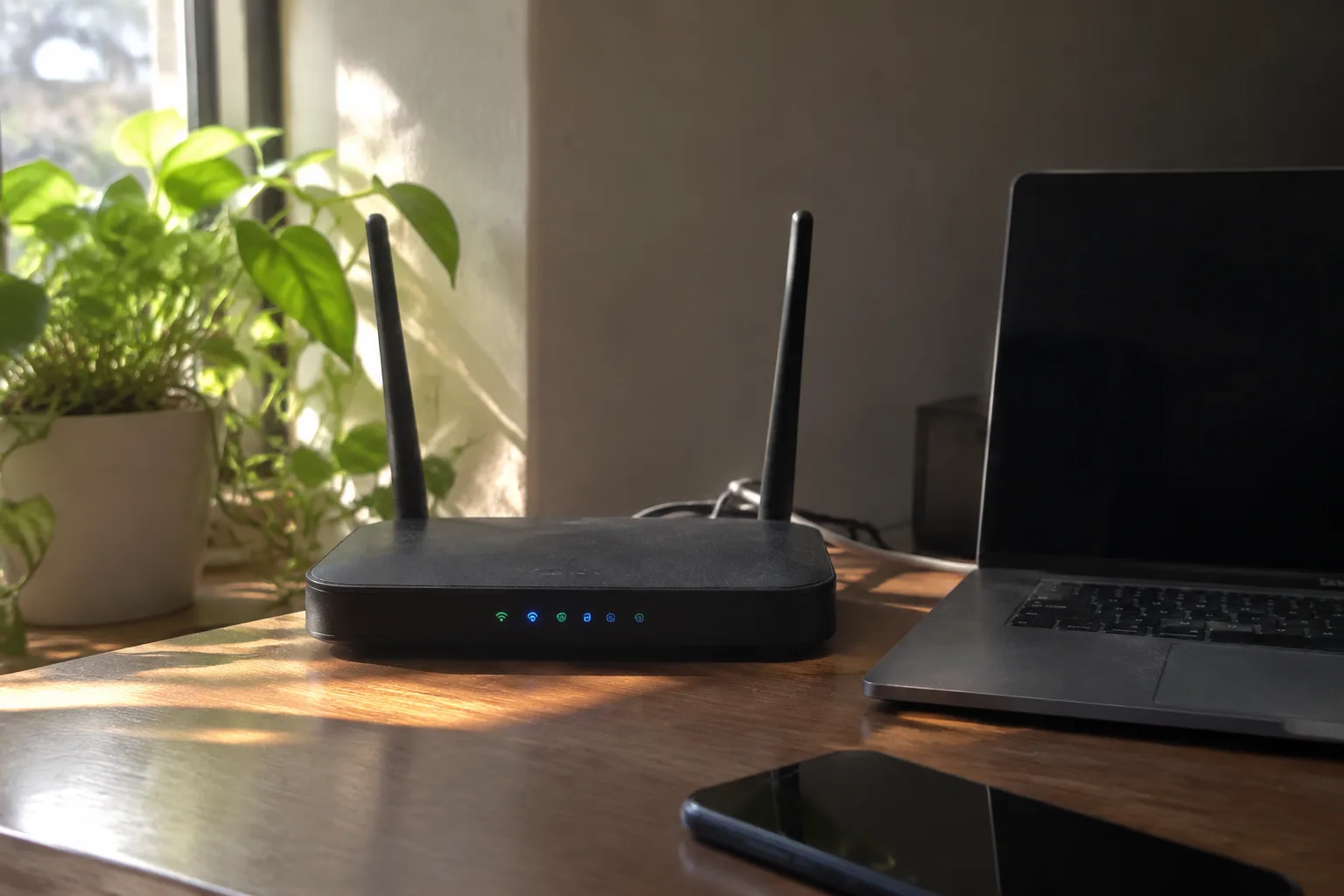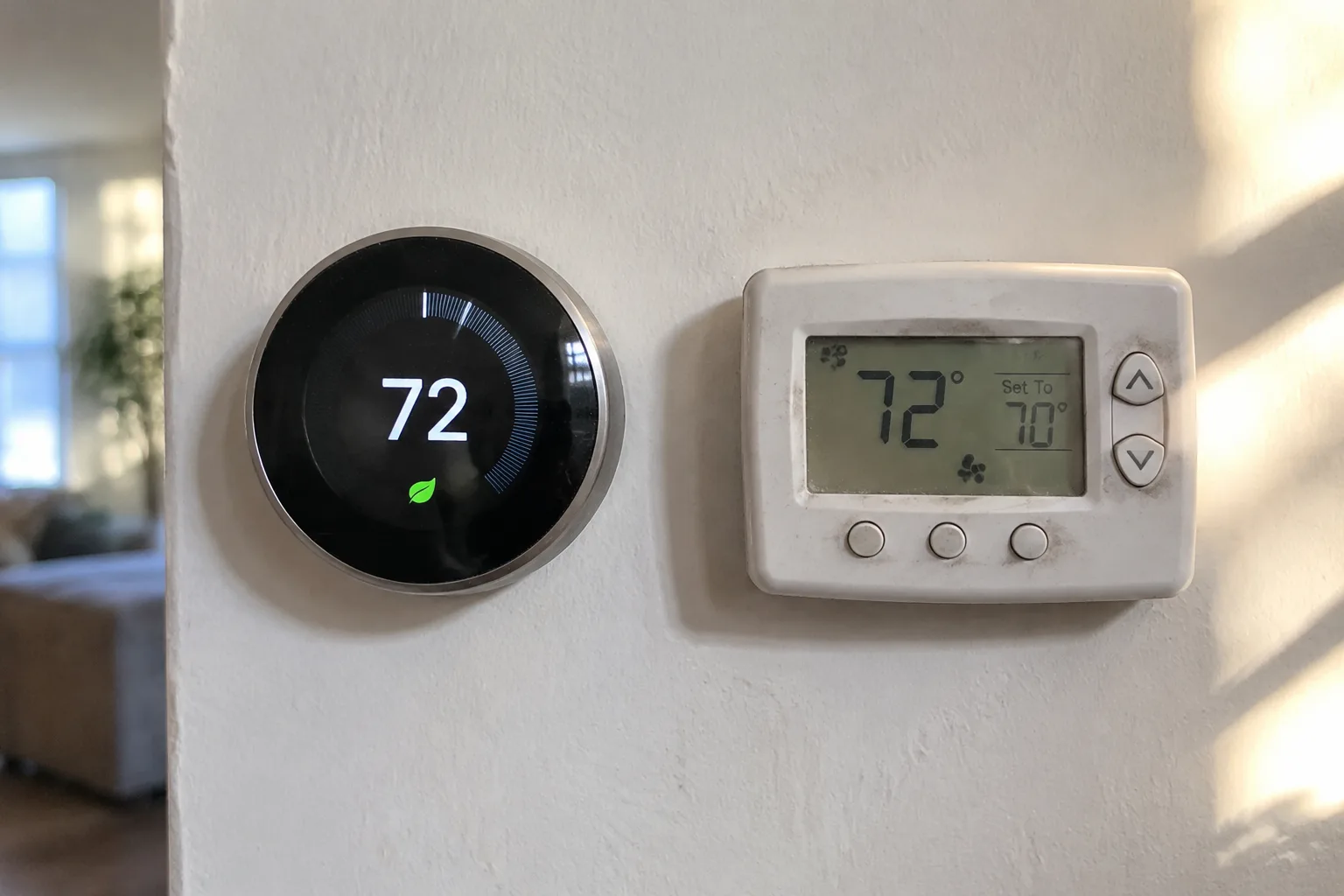
Two thermostats sit on the same shelf at the hardware store, often for similar money, and they promise the same thing: lower heating and cooling bills. One costs about $30 and has four buttons and a small LCD. The other costs $250, connects to Wi-Fi, learns a household's schedule, and reports energy use in a phone app. The price gap suggests a performance gap. It does not always work out that way.
What separates the two devices is not quality but control. A programmable thermostat runs a schedule a person enters. A smart thermostat builds or adjusts a schedule on its own, using occupancy sensing, geofencing, weather data, and algorithms that claim to understand a home's thermal behavior. The question of which saves more comes down to how well each device matches the actual life happening inside the house.
What a programmable thermostat actually does
The programmable unit is a timer with a thermometer attached. Most models allow four daily periods (wake, leave, return, sleep) and separate schedules for weekdays and weekends. Set the heat back to 62 degrees from 8 a.m. to 5 p.m., bring it to 68 when the house fills up again, and the device executes that pattern every day until someone changes it.
The energy logic is sound and old. The U.S. Department of Energy has long recommended setting back a thermostat 7 to 10 degrees for eight hours a day, a routine that can trim heating and cooling costs by roughly a tenth over the course of a year. A $30 device can deliver that saving completely, provided the schedule reflects real life.
That proviso carries most of the weight. A programmable thermostat has no idea whether anyone is home. It fires the furnace at 5 p.m. on a Tuesday whether the family is walking in the door or stuck at a relative's house. It also has no idea that a retired resident is home all day, which makes the "leave" period a waste of a perfectly good setback.
Where the smart thermostat earns its price
Smart thermostats attack the mismatch between schedule and reality. Geofencing uses the location of residents' phones to switch to an away setting when the last person leaves and to resume comfort when someone is heading back. Occupancy sensors catch the case where a phone stays home but a person does not, or the reverse.
The learning models go further. Nest, Ecobee, and Honeywell units observe when a house is usually occupied, how long it takes to reach a set temperature, and how outdoor weather shifts the load. After a week or two, the device stops asking and starts predicting. For a household with an irregular schedule, that adaptability is the entire value proposition.
There is a second saving that rarely makes the marketing copy: the phone app. A person can drop the heat from an airport gate or raise it from a hotel room before driving home. Programmable units require walking to the wall. That friction matters. A schedule that is five years stale because nobody wants to reprogram the thing saves nothing at all.
The habit problem that erases the difference
Here is the uncomfortable finding that shows up whenever utilities study thermostat behavior: a large share of programmable thermostats are never programmed. Installers leave them on a factory default, or a resident sets one schedule and never touches it again. A device capable of 10 percent savings delivers zero when it runs like a manual thermostat set to 70 degrees around the clock.
Smart thermostats partially sidestep this failure because the learning happens without user effort. The device programs itself. But the same studies suggest the savings from smart units are often smaller than advertised, in the range of a few percent for many households, precisely because the baseline household was already reasonably efficient or because the algorithm's guesses are conservative.
The variable that dominates both categories is the person. A diligent owner of a $30 programmable unit who builds an accurate schedule and updates it seasonally will beat a careless owner of a $250 smart unit every winter. The hardware sets a ceiling on savings. Behavior determines how close to that ceiling a house actually gets.
Heat pumps and the setback question
A complication has entered the picture with the spread of heat pumps. Older gas furnaces recover from a setback quickly, so deep nighttime setbacks are pure profit. Heat pumps are more efficient when they run steadily at a moderate output, and a large setback can force the system into an expensive auxiliary heating mode to catch up in the morning.
Smart thermostats handle this better than most programmable ones because they can learn recovery times and start warming early at a gentle rate. Some models also integrate with utility demand-response programs, shaving load during peak events in exchange for a credit. That feature requires connectivity, which puts it out of reach of the programmable unit entirely.
For a household with a heat pump, the smart device's advantage widens. For a household with a conventional furnace and a rigid weekly routine, the advantage narrows to almost nothing.
The rebate math that flips the price comparison
Sticker price misleads. Many electric and gas utilities offer rebates of $50 to $100 on qualifying smart thermostats, and some efficiency programs discount them further. In parts of the country, a $250 unit lands at $100 or less after incentives. At that price, the payback period against a $30 programmable model can shrink to a single heating season in a poorly scheduled home.
The rebate is not charity. Utilities fund these programs because aggregated thermostat setbacks reduce peak demand, which is expensive for the grid to serve. The customer gets a cheaper device; the utility gets load relief. A programmable thermostat almost never qualifies for these programs because it cannot be controlled remotely.
A concrete comparison for a typical household
Picture a family of four in a 2,000-square-foot house with a gas furnace, both adults working outside the home on weekdays, kids in school, everyone home on weekends. Annual heating and cooling costs run around $1,800. A programmable thermostat set to 62 during work and school hours and 68 otherwise could plausibly cut 8 to 12 percent, or roughly $150 to $215 a year.
A smart thermostat in the same house adds geofencing that catches the occasional weekday when the family is out late, plus seasonal auto-adjustments. Realistic extra savings over the well-programmed unit: perhaps $20 to $40 a year. Against a $220 price gap (before rebates), the smart unit takes years to break even on energy alone.
Now change one detail: the household includes a parent working from home three days a week. The fixed programmable schedule now sets back the house on days someone is in it, forcing manual overrides and erasing the savings. The smart unit's occupancy sensing adapts automatically. In this house, the smart thermostat likely wins within two seasons.
When the cheaper device is the better buy
A programmable thermostat is the right purchase for a household with a stable, predictable weekly rhythm and at least one person willing to spend twenty minutes setting a schedule correctly and revisiting it when seasons change. Retired couples, shift workers with consistent patterns, and anyone who genuinely enjoys fiddling with settings fall into this group.
The smart unit fits irregular lives: remote workers, frequent travelers, households where schedules shift month to month, and homes with heat pumps that benefit from learned recovery. It also fits anyone who will never program a schedule by hand but will happily let an app do it.
The honest answer to which saves more on bills has two branches, and the branch point is the household's routine. The device that matches the life inside the house saves more. The one that fights it saves nothing, regardless of what the box claims.