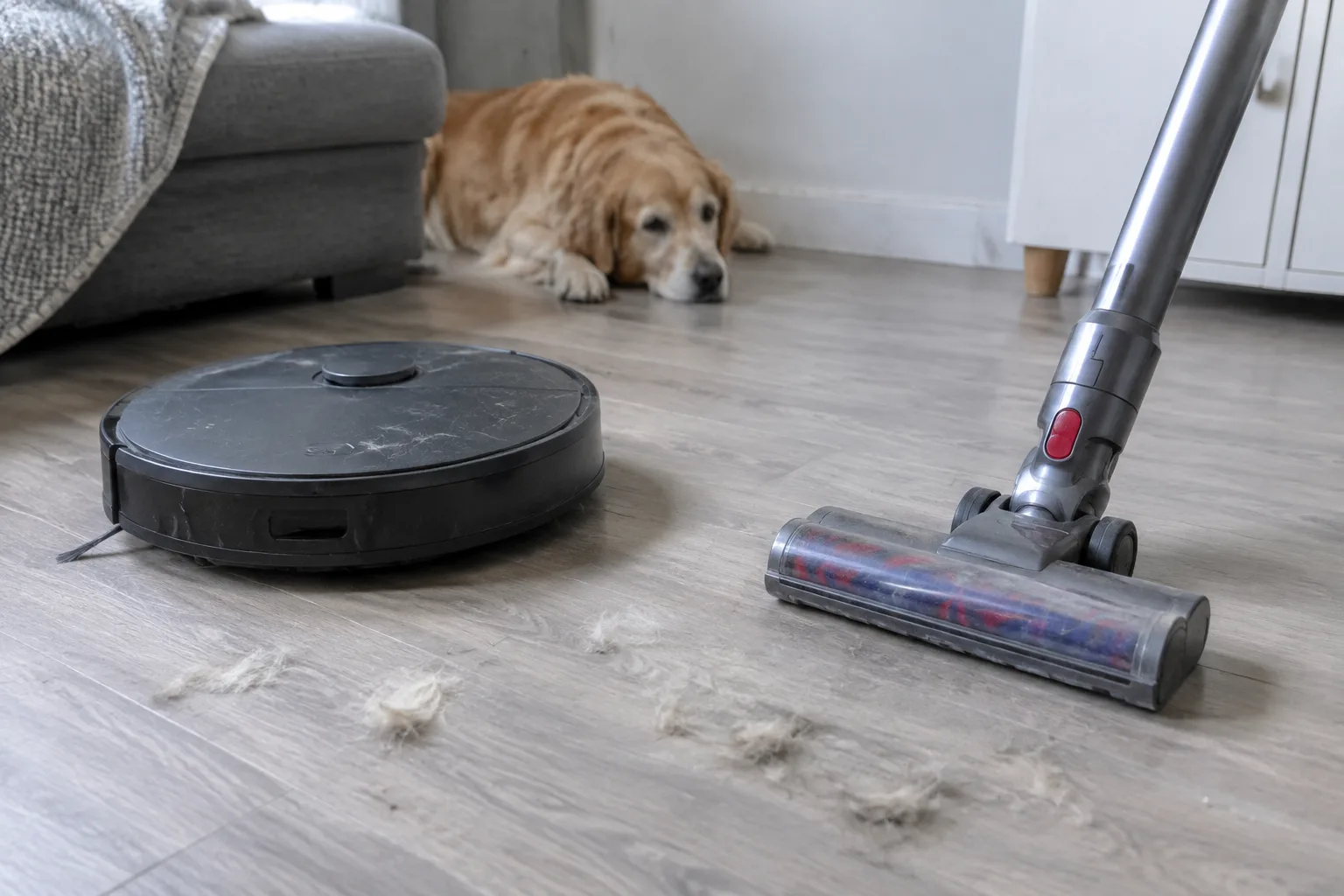
Pet hair does not fall evenly. It gathers in a crescent along the base of the sofa, packs itself into the nap of a cheap rug, and threads into carpet fibers with a tenacity that borders on biological. Any vacuum that claims to handle it will be judged on the surfaces where hair actually accumulates, not on the showroom floor. Robot vacuums and cordless stick vacuums approach this problem from opposite directions, and the honest answer about which wins depends on which kind of pet hair is being discussed.
One cleans by attrition, running a small brush across the same patch of floor dozens of times a week. The other cleans by force, concentrating suction and agitation into a few deliberate minutes. Neither is simply better. They fail differently, and those failure modes matter more than the spec sheets.
The Daily Grind Against Shedding Season
A short-haired dog sheds continuously. A few hairs on the floor after breakfast, a few more after lunch, a slow accumulation that never announces itself. For that kind of load, a robot vacuum running a daily or every-other-day schedule does something a stick vacuum cannot: it removes hair before it becomes visible.
The math is unglamorous. A robot covering 1,000 square feet in ninety minutes picks up a thin layer of hair each pass. Over a week, that is seven thin layers intercepted before they mat into the carpet. A stick vacuum used twice a week captures the same total volume but leaves the hair to sit and compact in between. Compacted hair is harder to lift.
Robots also get under beds and behind toilet bases, places where hair drifts and where a person with a stick vacuum rarely bothers to reach. That matters more than raw suction power. The dust bunny forming in the shadow under a dresser is not defeated by a stronger motor; it is defeated by a machine small enough to get there on a Tuesday afternoon while nobody is home.
Where the Robot Chokes on Long Fur
Long-haired cats and double-coated dogs produce hair with structure. It clumps. It wraps. A robot's brush roll is a spool, and long hair winds around that spool the way fishing line winds around a reel. Within a few weeks, the roll is a felted cylinder with bristles buried inside it, spinning inefficiently and dragging rather than sweeping.
The vacuum does not announce this failure. It keeps running its schedule, keeps returning to its dock, keeps reporting a clean floor while actually smearing a thin film of hair across the kitchen tile. Owners discover the problem when the machine starts leaving visible streaks or when a maintenance reminder finally prompts a look underneath.
Rubber brush rolls and blade-style rollers resist tangling better than bristle brushes, and some robots now ship with comb teeth that shear hair as the roll turns. These help. They do not eliminate the problem. A heavy shedder in a small apartment can foul a robot roll in under a month, and clearing it means flipping the machine, pulling the roll, and cutting hair free with scissors or a seam ripper.
The Stick Vacuum's Case for Raw Torque
Cordless stick vacuums win on power density. A modern stick pulls 100 to 150 air watts through a motorized floor head, and the good ones drive a brush roll hard enough to agitate carpet pile and fling embedded hair into the airflow. On a rug where a dog has slept for a week, that difference is visible: the stick lifts the hair in one or two passes, while a robot needs several scheduled runs to reach the same result.
The stick also lets a person see the hair as it goes. That sounds trivial until the floor is checked after a robot's scheduled run and a clump near the baseboard turns out to have been missed for days. A person pushing a stick vacuum watches the debris enter the head. There is immediate feedback, and that feedback drives a second pass over the spot that was skipped.
Sticks handle furniture edges and stairs without complaint. They can be lifted onto a couch cushion, run along a baseboard, or aimed at the pile of hair that collects beside a litter box. Robots cannot do stairs, are clumsy around cords and rug fringe, and their round shape leaves a small untouched ring at every corner.
Hair Wrapped Around the Brush Bar
Both machines tangle, but the consequences differ. A tangled robot brush bar means degraded cleaning on every future run until the owner notices. A tangled stick brush bar means the vacuum suddenly feels weak and starts spitting debris back onto the floor, which prompts immediate investigation.
The stick's tangle problem is at least visible and repairable in the moment. Pop the brush bar out, cut the hair, slide it back. The robot's tangle hides under the chassis where nobody looks without a reason.
There is a partial fix worth mentioning: anti-tangle combs and tapered brush bars are now common on both machine types, and they do reduce wrap on short to medium fur. On the long, fine hair from a Maine Coon or a Golden Retriever's undercoat, they buy time rather than solve the problem.
Filtration and the Fine Hair Problem
Pet hair is not only the visible clumps. It also produces fine dander and broken hair fragments that pass through a coarse filter and get blown back into the room. A vacuum that lifts hair but exhausts fine particles is a lateral move for anyone with allergies.
Stick vacuums generally carry larger, more substantial filter assemblies because they have room for them and because their short, high-velocity air path demands good filtration. Robots cram a filter into a small bin, and the small bin fills quickly with hair, which reduces airflow and pushes more work onto the filter.
On a floor with heavy pet hair, a robot's bin may need emptying every single run. A stick's bin might hold two or three rooms' worth before it needs attention. That bin-size difference shapes the whole ownership experience.
The Case for Running Both
The households that report the cleanest floors with pets tend to run both machines, and the division of labor is specific. The robot handles the daily maintenance pass across hard floors, under furniture, and in low-traffic corners. The stick handles the weekly deep clean on rugs, the sofa, the stairs, and the pile of hair that accumulates where the dog sleeps.
That arrangement costs more than either machine alone, and it requires storage space for two devices. It also reflects how the two tools actually fail. The robot's weakness is depth and power, which the stick covers. The stick's weakness is frequency and reach, which the robot covers. Neither machine alone covers the whole hair problem in a shedding household.
The Floor Type That Decides It
Hard flooring changes the calculation. On tile, laminate, or sealed wood, hair does not embed; it sits on the surface and drifts. A robot with a decent side brush and moderate suction handles that load well, and the daily schedule keeps the floor clear of the loose tufts that gather along walls and under the toe kick of kitchen cabinets.
Carpet and rugs reverse the verdict. Hair works its way into the pile, and only agitation plus airflow pulls it back out. A stick vacuum with a motorized head is the better tool here, and the deeper the pile, the wider the gap. A robot on medium-pile carpet does a maintenance pass, not a deep clean, and the difference shows when the carpet is walked on barefoot and the fibers feel stiff with trapped hair.
What a Heavy Shedder Actually Needs
For a household with one short-haired cat and mostly hard floors, a robot vacuum is the higher-value purchase. It removes the daily drift of hair before it becomes a chore, and the maintenance burden is a weekly brush-roll check and a bin empty every day or two.
For a household with a double-coated dog and wall-to-wall carpet, the stick vacuum is the machine that does the real work, and a robot is a supplement at best. The stick's motorized head and larger bin match the load. The robot's schedule cannot compensate for the lack of agitation depth.
The deciding factor is not which machine is more advanced. It is which failure mode a household can tolerate. A robot that quietly underperforms on carpet is worse than no robot, because it creates the illusion of clean. A stick vacuum that sits in a closet because nobody wants to drag it out is equally useless. The pet hair on the floor does not care about the spec sheet. It only cares whether something reaches it, agitates it, and carries it away.