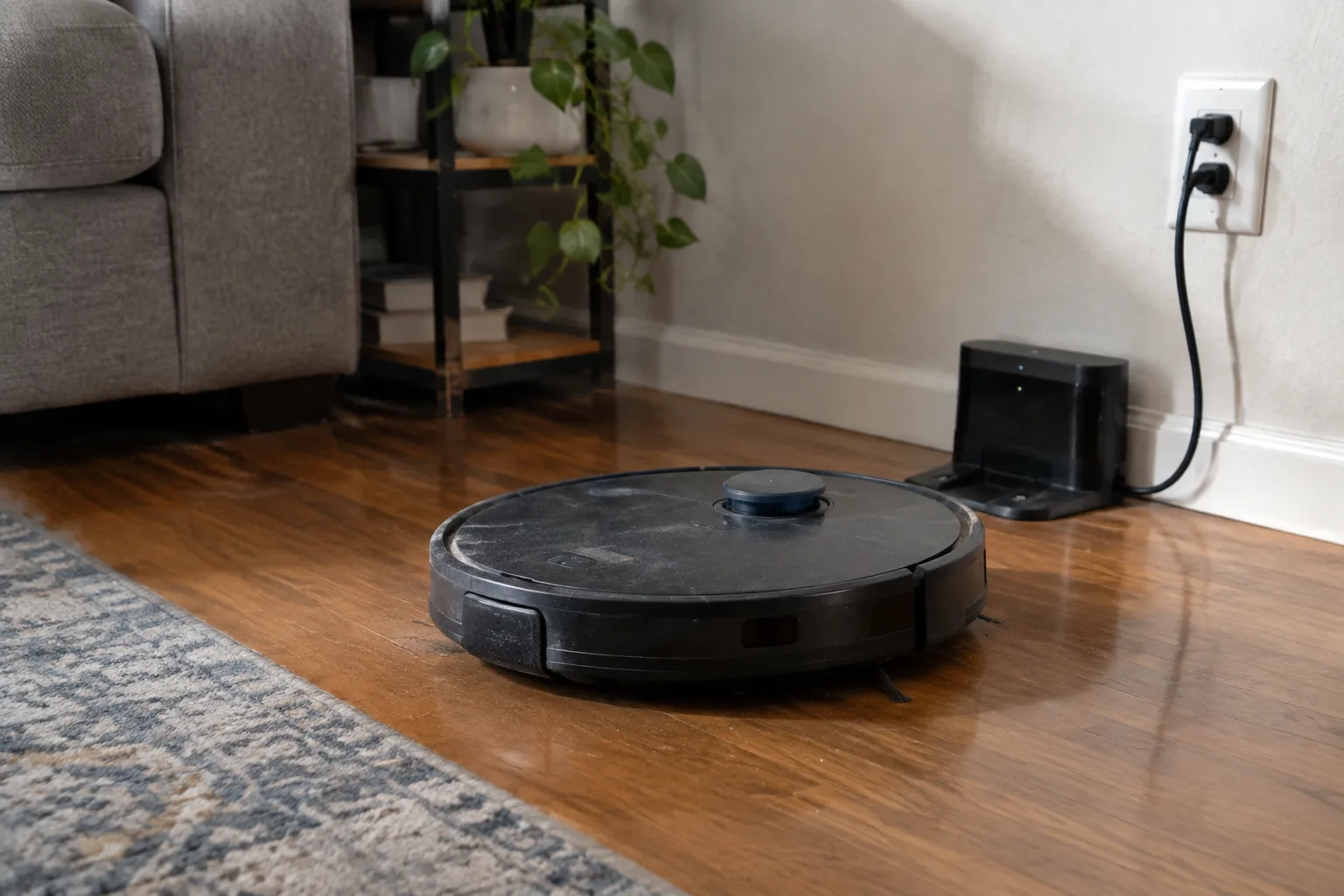
The first bill a robot vacuum sends is not the one on the receipt. It arrives later, in small increments: a few cents of electricity, a replacement filter, a battery that quietly loses capacity over a couple of years. None of these is dramatic on its own. Added together across a year of daily cleaning, they turn a gadget that looked like a one-time purchase into a modest ongoing subscription, paid in parts and power.
The honest way to work out what daily robot vacuuming costs is to break the machine into its consumable pieces and price each one at realistic intervals. The figure that comes out the other end is smaller than most people fear and larger than the sticker price suggests.
The electricity number is tiny, and that matters
A typical robot vacuum draws somewhere in the range of 30 to 60 watts while it works. An average cleaning run lasts an hour, sometimes less on a small apartment floor. Run the arithmetic at 40 watts for a full hour and the machine consumes about 0.04 kilowatt-hours per day. At a residential electricity rate of roughly 15 to 20 cents per kilowatt-hour, a daily run costs somewhere around a penny.
Over a year, that lands in the neighborhood of three to five dollars. Even a higher-draw model with a mop function and a self-emptying base, which charges and runs a small fan in the dock, pushes the annual figure only into the low double digits.
This is the part of the cost story that gets the most attention and deserves the least. Electricity is a rounding error. The money sits elsewhere.
Filters are the quiet recurring expense
Every robot vacuum pulls air through a filter, and that filter clogs. Manufacturers typically recommend replacing the main filter every two to three months, or roughly every sixty to ninety cleaning cycles. A daily schedule means the machine hits that cycle count fast.
Replacement filters for common models run about five to fifteen dollars each when bought in multipacks. Call it ten dollars a filter, four filters a year, and the filter line alone comes to roughly forty dollars annually. Cheaper third-party filters exist, and they cost less for a reason: looser pleats, thinner media, a worse seal. A person who has watched fine dust settle back onto a baseboard after a cheap filter went in tends to stop bargain-hunting.
Filter cost scales directly with how often the machine runs. Daily use means four changes a year. Twice-weekly use means one or two. The difference is not huge in absolute dollars, but it is the first place where daily operation visibly costs more than occasional operation.
Brushes wear down against the floor
Two kinds of brush do the work: a rubber or bristle roller underneath, and small spinning side brushes that flick debris out of corners. Both abrade against flooring and both fail on a schedule.
Side brushes are the faster wear item. Their bristles splay and curl within a few months of daily use, and a splayed side brush stops reaching into corners, which is precisely the job it exists to do. A set of replacements costs a few dollars to around fifteen, depending on the brand, and daily running might mean two or three sets a year.
The main roller lasts longer, often six to twelve months, but it is pricier, sometimes twenty to forty dollars for an OEM part. Hair tangles around it, grit grinds at the rubber, and on carpet the bristles flatten. A household with long hair or a shedding dog will replace rollers faster than a bare-floor apartment with a short-haired occupant.
The battery sets the real two-year horizon
Lithium batteries degrade with every charge cycle, and a daily run means a charge cycle nearly every day. Most robot vacuum batteries hold useful capacity for somewhere between two and four years of regular use, with daily operation pushing toward the shorter end.
A replacement battery for a common model typically runs thirty to eighty dollars. Spread over a two-to-three-year life, that is maybe twenty to thirty dollars a year, but it arrives as a single unwelcome purchase rather than a trickle. The symptom is familiar: the machine used to finish the whole floor on one charge and now returns to the dock halfway through, or it starts a second pass it never needed before.
Battery cost is where daily running leaves the clearest mark. A machine run twice a week might get four or five years from a battery. The same machine run every day is shopping for a replacement in two.
Dust bags and mop pads add their own line items
Self-emptying bases have made the docking station a cost center of its own. The base sucks debris from the robot's bin into a bag, and that bag fills. In a home with pets, a bag might last a month or two under daily cleaning; in a tidy apartment, three or four months. Bags run a few dollars apiece in multipacks, so the annual total is modest, perhaps fifteen to forty dollars.
Models with a mopping function add washable or disposable pads. Washable pads are cheap to own but need laundering, which carries its own water and detergent cost. Disposable pads are convenient and run a few dollars each, and daily mopping burns through them quickly. A household that mops daily with disposables can spend more on pads in a year than on electricity, filters, and brushes combined.
A realistic annual total for daily running
Stack the recurring items for a mid-range robot vacuum run once a day in a home with a pet, using manufacturer parts and no mopping:
Electricity: roughly five dollars. Filters: about forty. Side brushes: fifteen to thirty. One main roller replacement, amortized: twenty to forty. Battery, amortized across its shortened life: twenty-five to thirty-five. Dust bags: twenty to forty. That lands somewhere between roughly 125 and 190 dollars a year, before any mop pads or repairs.
Drop to twice-weekly cleaning and the same machine's annual consumables cost falls to perhaps sixty to ninety dollars, mostly because the battery lasts longer and the filters and brushes stretch further. The gap between daily and occasional is real, on the order of fifty to a hundred dollars a year, and almost all of it comes from wear items rather than power.
What daily running buys in return
The case for daily operation rests on what it prevents. A robot that runs every day never lets grit accumulate, so the floor stays ahead of the point where abrasive particles start dulling a hardwood finish. It keeps pet hair from matting into carpet fibers. It means the machine's bin never overfills and never dumps a clump of debris back onto the floor mid-run.
There is a maintenance argument too. Frequent short runs are gentler on a battery than deep discharges, and a machine that starts each day with a full charge and a clean filter performs closer to spec. The daily schedule is, in a sense, the operating condition the hardware was designed around.
Against that, daily running accelerates every wear item on the list. The question a household actually faces is whether cleaner floors every day are worth roughly a hundred and fifty dollars a year in parts, plus the labor of swapping filters and untangling brushes. For a household with shedding pets or allergy concerns, the answer is often yes. For a small, tidy apartment with hard floors and no pets, twice a week does nearly the same cleaning for half the consumable spend.
The hidden cost is attention, not parts
The dollar figures are modest enough that they rarely decide the question. What daily running actually demands is a standing appointment with maintenance. Filters need checking, brushes need clearing of hair, the bin needs emptying, and the battery needs watching for the first sign of decline. Skip these and the machine's cleaning performance quietly degrades while the electricity bill stays the same.
A person who runs a robot vacuum every day and never opens the brush housing is paying for a machine that is slowly cleaning less well. The consumables budget is only honest if the maintenance actually happens. The parts are cheap; the discipline is the expensive part.
Set against a professional cleaning service or the hourly cost of doing the floors by hand, a hundred and fifty dollars a year in parts is a bargain. The robot earns its keep on the days it runs unattended while the household is elsewhere, and the true cost of daily operation is the small, repeated act of keeping it in condition to do so.